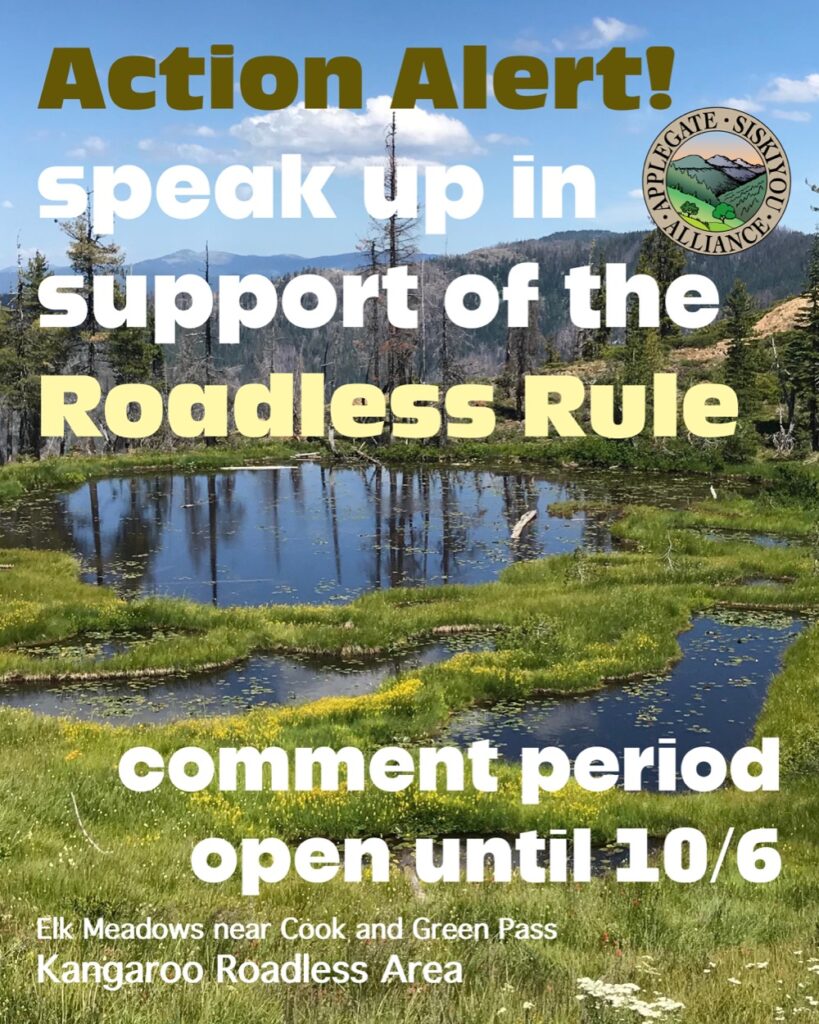
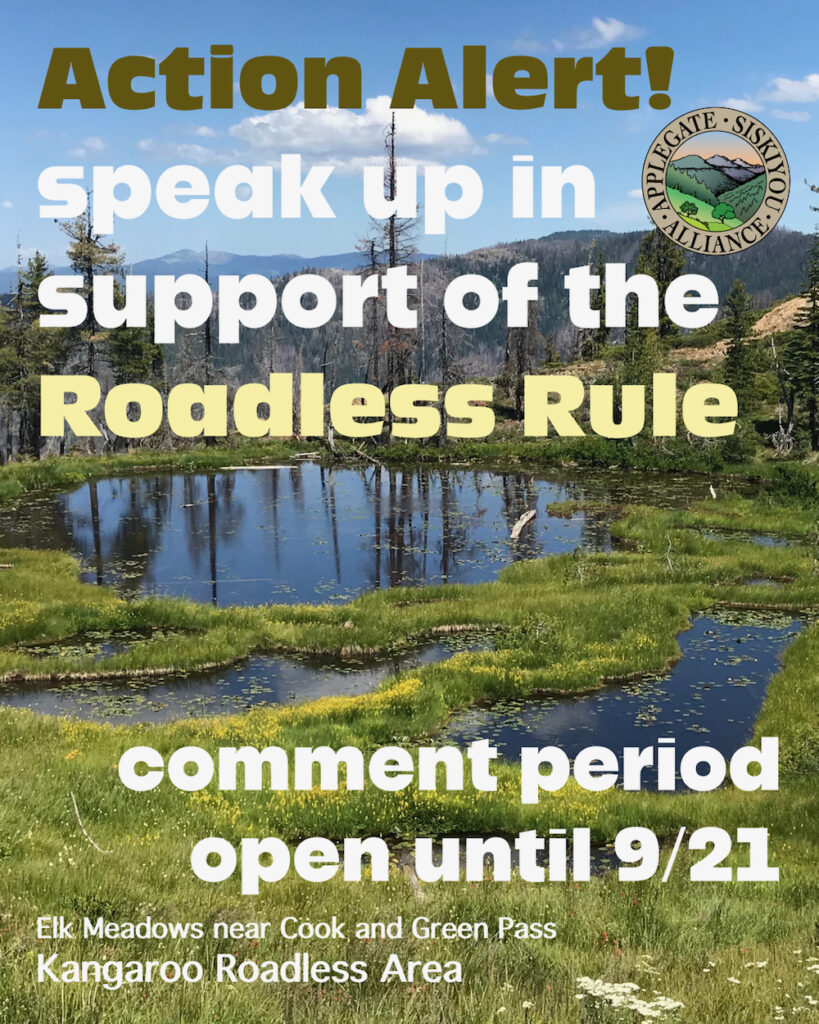
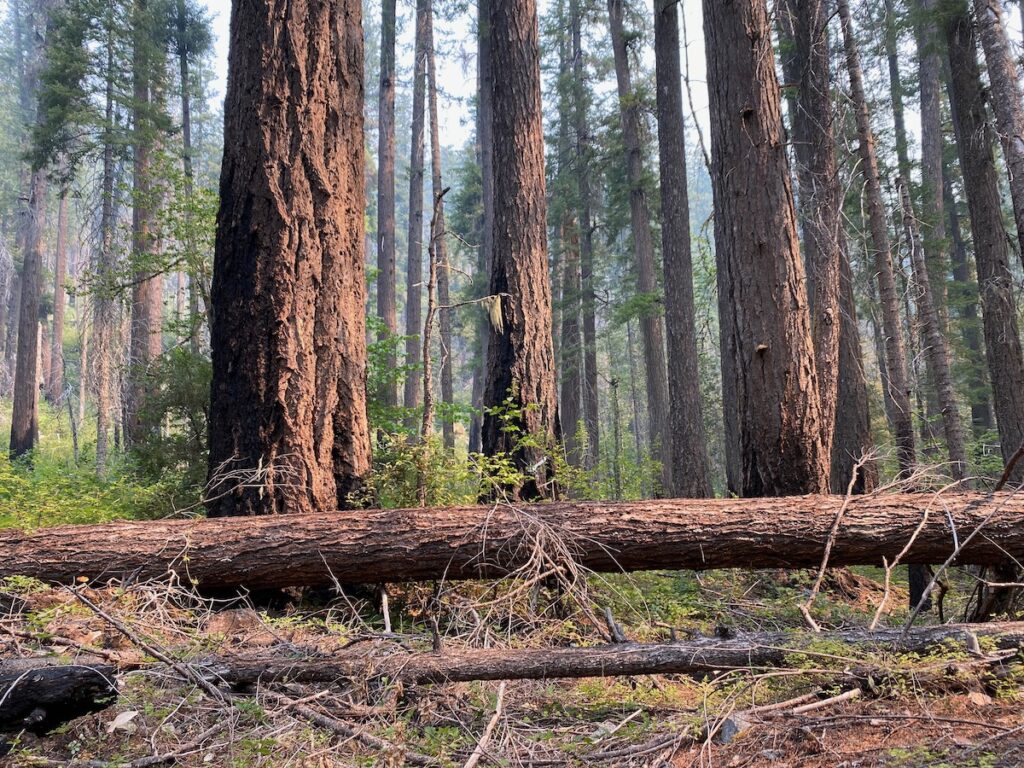
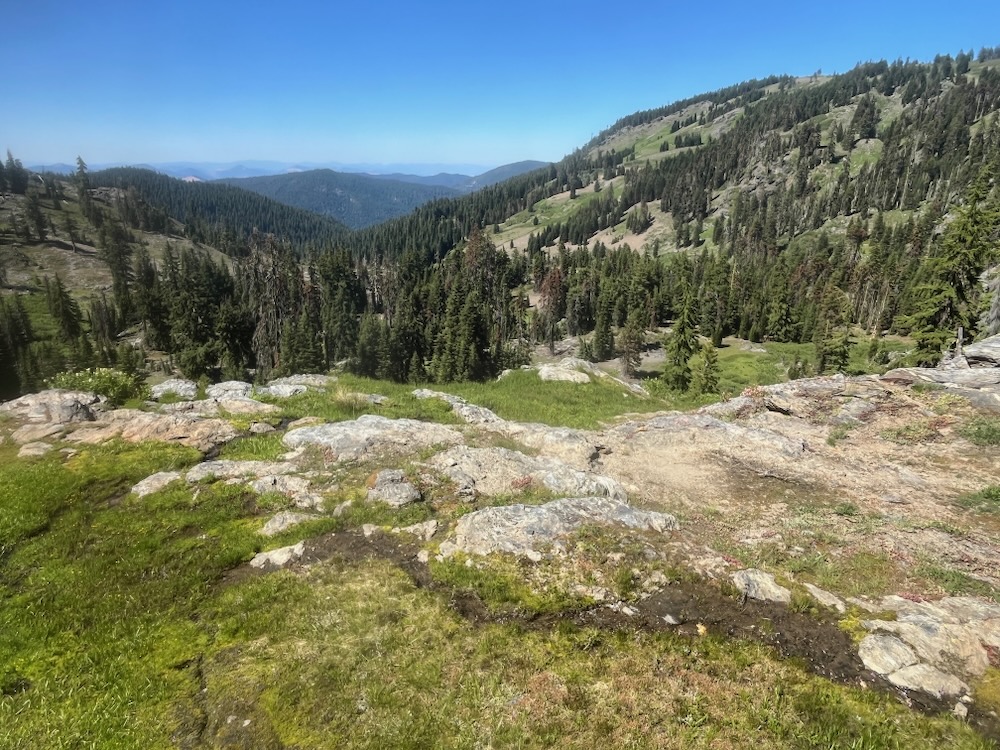
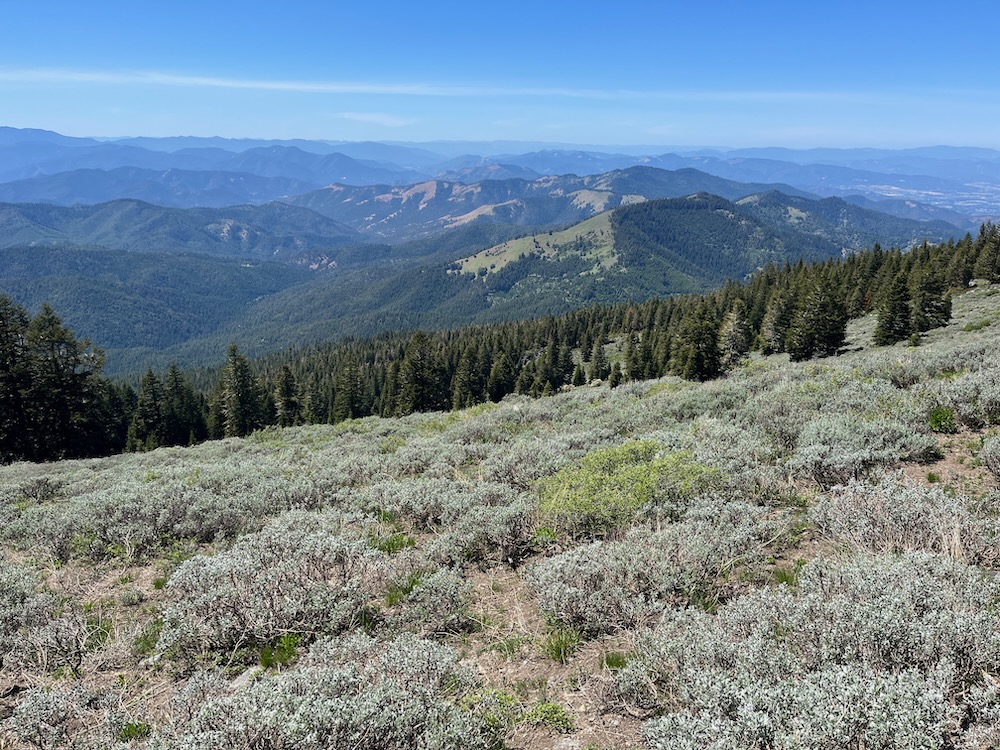
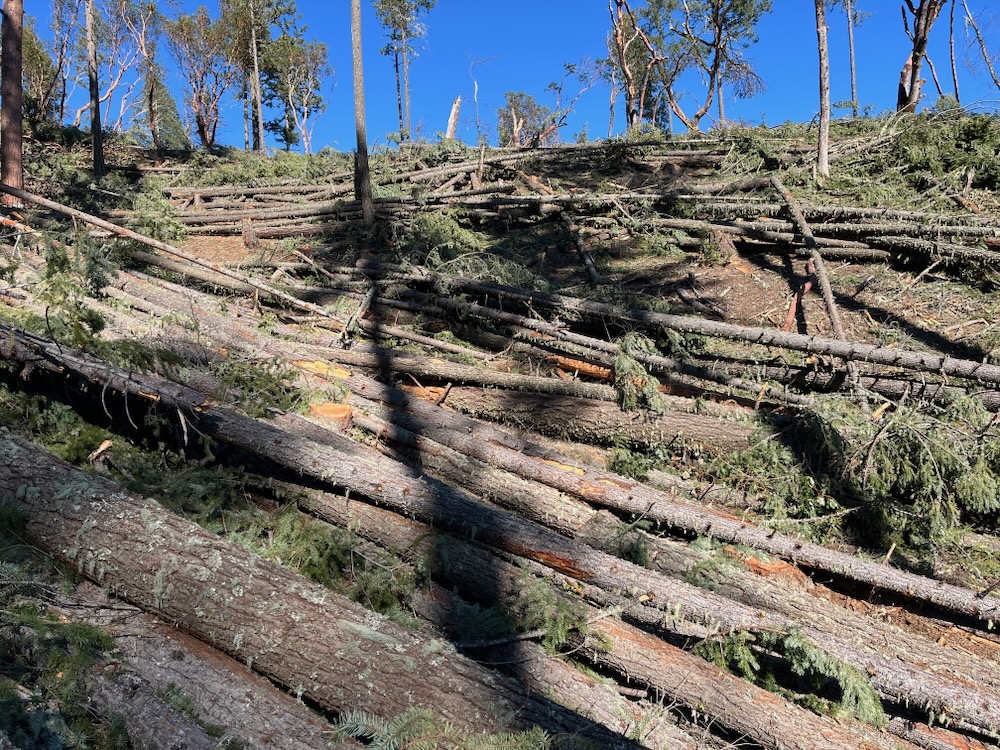
Tomorrow, October 6th is the deadline to submit your comment in support of the Roadless Rule that protects wild, roadless places on our national forests, managed by the Forest Service, from road building, logging, mining and other ecologically destructive activities.
Directly submit your comment in support of keeping the Roadless Rule on the Federal Register site:
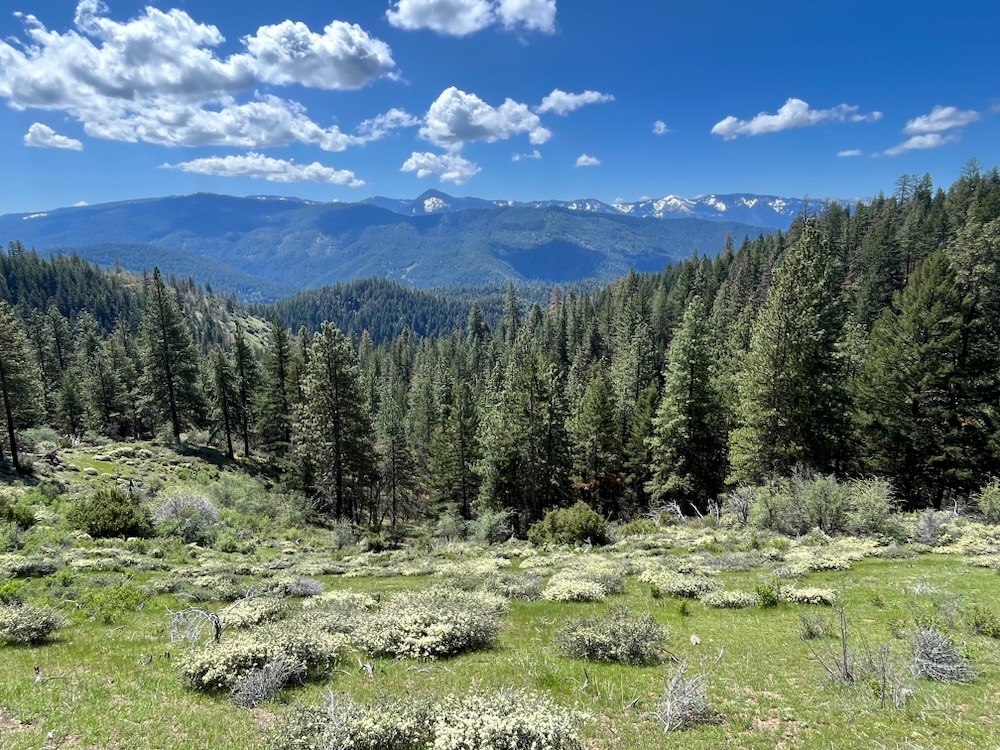
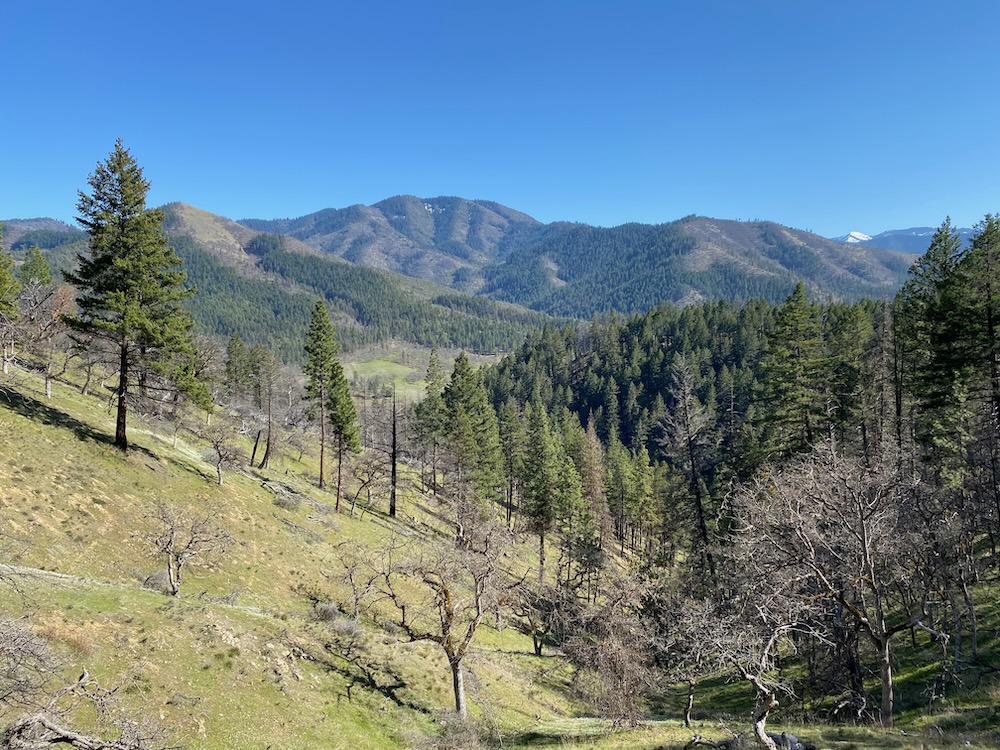
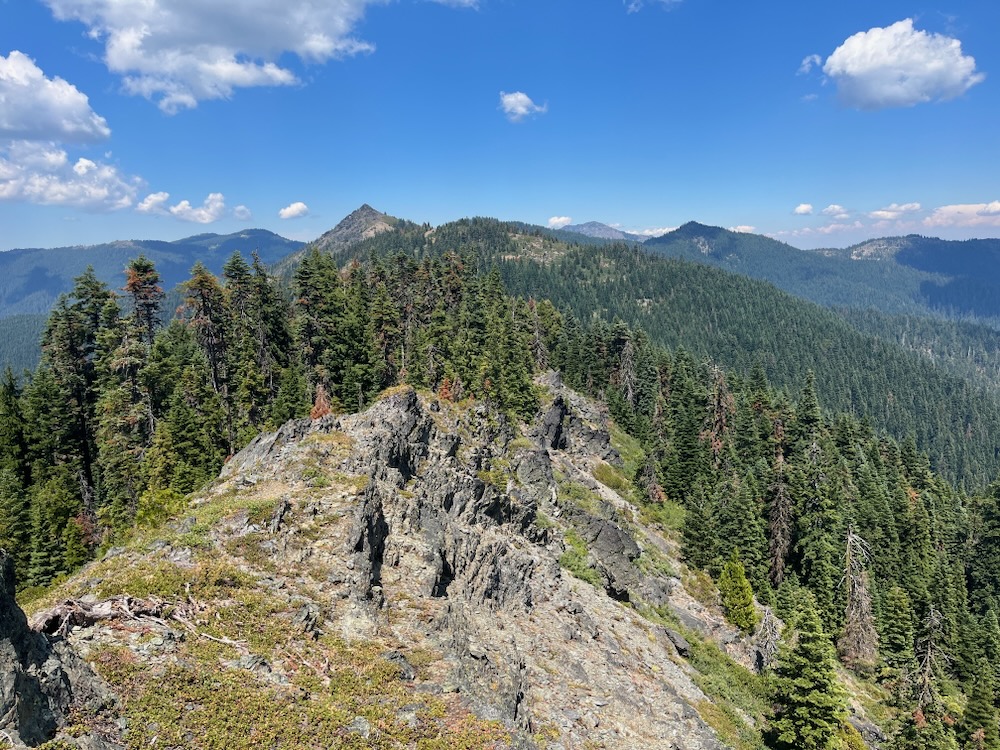
Watch Videos of the Wild & Beautiful Kangaroo Roadless Area!
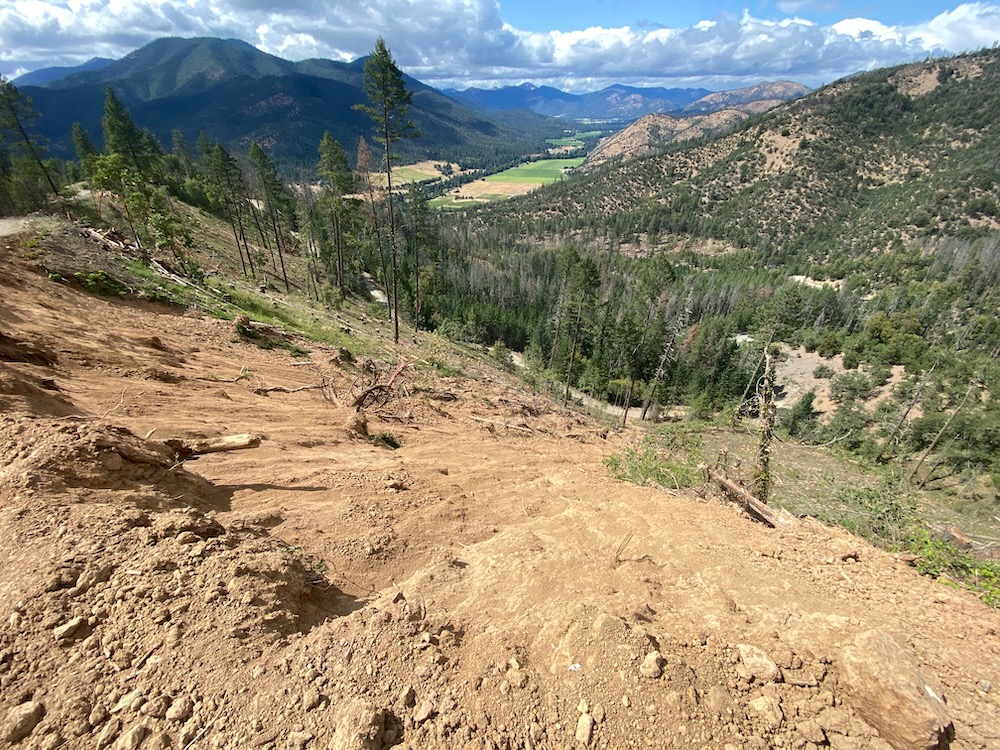
The biggest Roadless Area in the Applegate is the Kangaroo Roadless Area that straddles the California-Oregon border. Below is a series of videos highlighting different wild areas in the Kangaroo Roadless Area.
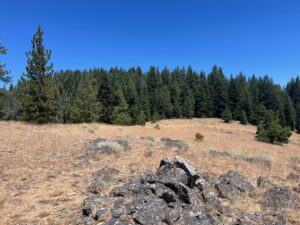
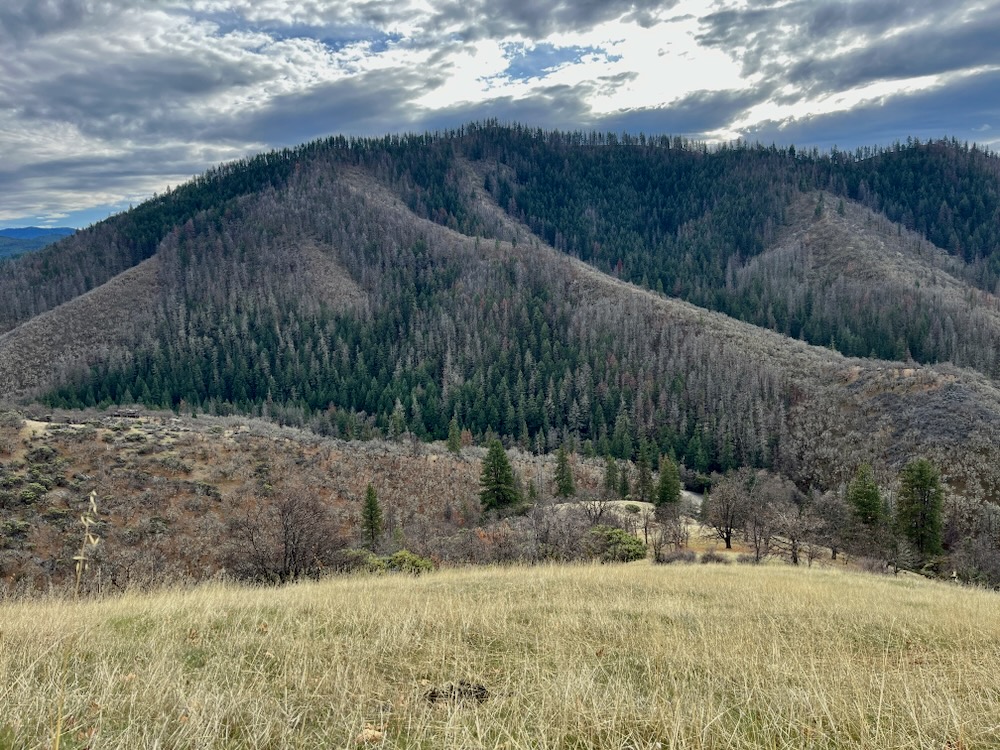
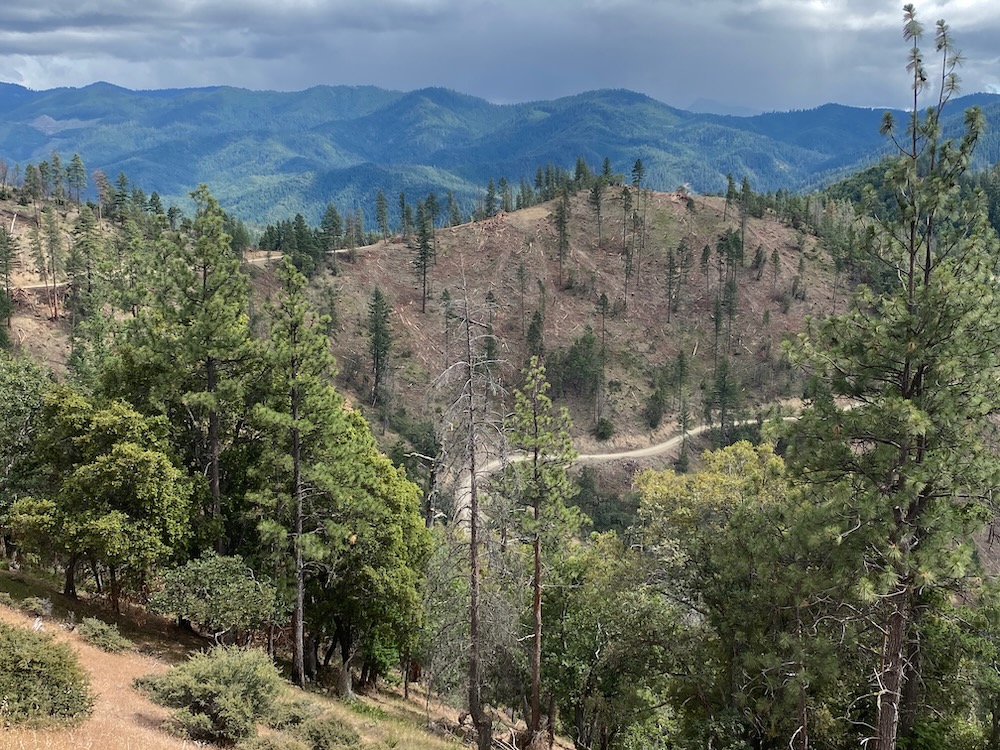
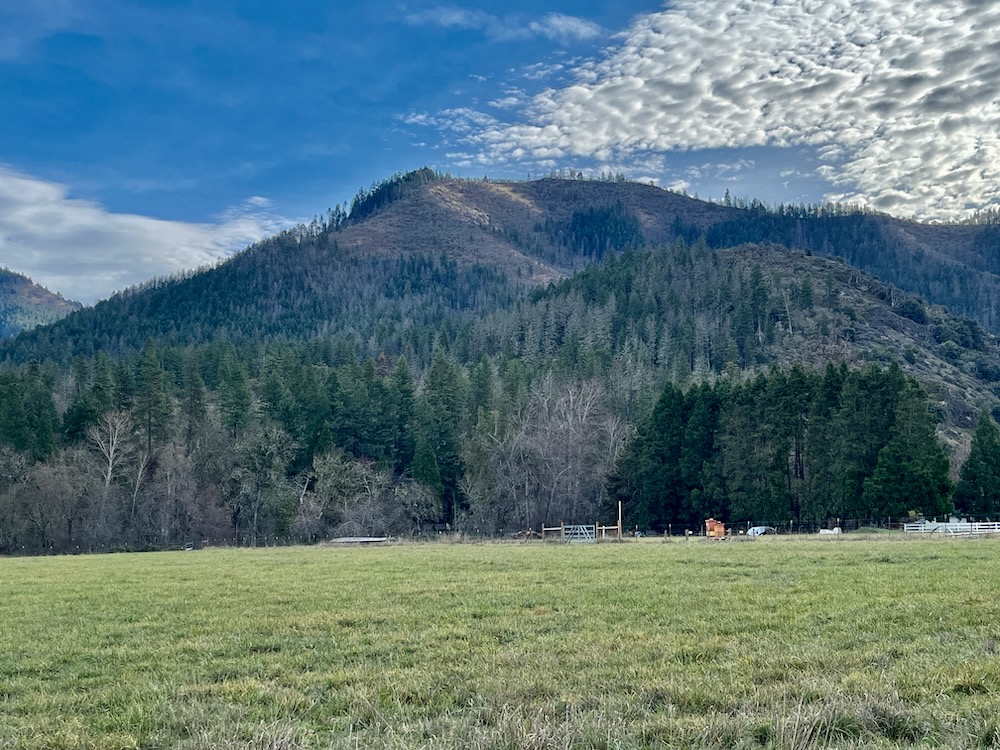
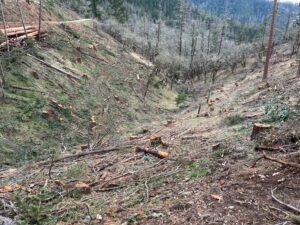
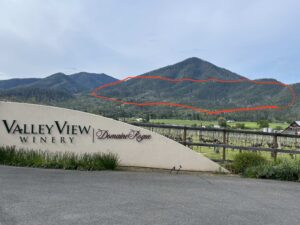
The green living forest reaching to the top of Deming Ridge on the right hand portion of the photo is proposed for logging in the Lone Wolf Timber Sale. The BLM claims this stand is dead and dying and proposes to “salvage” log the stand. Yet, as we have seen in other recent “salvage” operations, many living, green trees will be removed and very little living overstory canopy will be retained. The burned chaparral in the foreground was burned in the 2025 Deming Fire.
The Medford District BLM has approved the Douglas Fir Mortality Complex Environmental Assessment and has started releasing both decision records and setting timber sale auction dates for the newest Applegate logging projects. Identified as the Lone Wolf Timber Sale, the project proposes to log off 32 units and 747 acres. It would also build 2.4 miles of new permanent road in watersheds that already suffer both from excessive logging and high-density road networks.
The Lone Wolf Timber Sale contains a high concentration of timber sale units above Griffin Lane at the headwaters of Sterling Creek on Dutch Gulch, Grub Gulch and on Deming Gulch. In total, the BLM expects to log approximately 5.6 million board feet of timber and almost 23,000 merchantable trees. The Lone Wolf Timber Sale is also a virtual give away to the timber industry with the minimum bid being set at a little over $269,000. The public will be losing huge sums of money in the planning, design, layout and administration of this timber sale.
In short, this public forest give away would permanently alter and degrade the forests, watershed, and environment of the Applegate Valley by sacrificing our forests for timber industry profits, and doing so at the public’s expense.
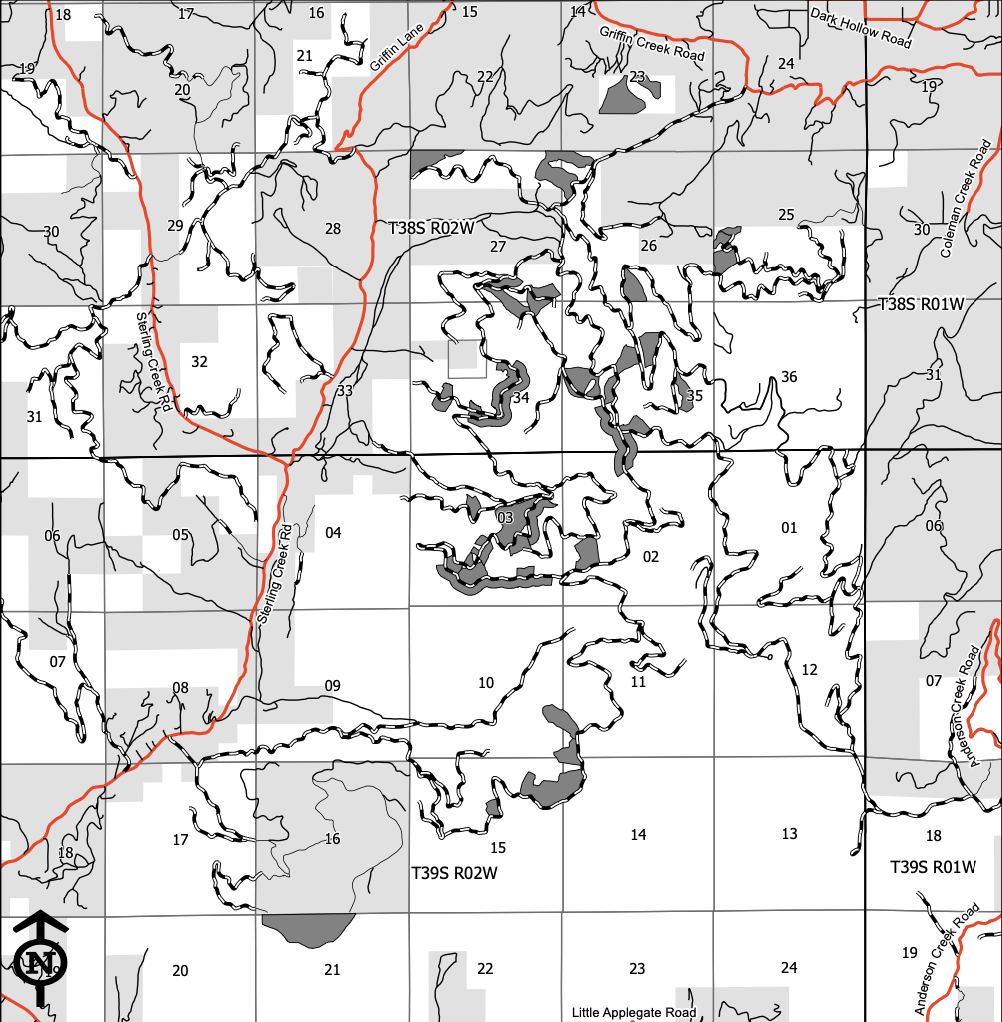
This map taken from the Lone Wolf Timber Sale Prospectus. It shows the timber sale units in dark gray. You can see Sterling Creek Road and Griffin Lane on the left. Most of the Lone Wolf Timber Sale is east of these two roads on the western flanks of Anderson Butte.
Like the current SOS Project, the Lone Wolf Timber Sale proposes more environmentally devastating “salvage” logging in stands of living, green trees, and in stands with significant recent beetle mortality. In both habitat types, the result is often to retain only a handful of trees per acre and virtually no canopy cover. Logging both green trees and dead standing snags has significant impacts to both the health of our local forests and the quality of habitat on the landscape for the northern spotted owl, the and the Pacific fisher.
The Lone Wolf Timber Sale would also log Riparian Reserves, build new roads, build new log landings, create extensive yarding impacts, and add sediment to local streams. Recent BLM salvage logging projects have triggered large landslides and debris flows that filled seasonal streams with mud, debris and sediment. They have also logged off Riparian Reserves, bulldozed seasonal streams, completely filled in stream channels, and converted Riparian Reserves into skid trails. These impacts are severe, long lasting, totally avoidable, and have become routine on our BLM lands.
The Lone Wolf Timber Sale also proposes to log off healthy, functional forest habitats, including LSR forests, mature and late successional stands, and stands that sustained minimal to no significant mortality during the previous drought and beetle mortality events. By logging the survivors, the BLM is permanently degrading the forests of the future, and is proposing to log off the majority of forested habitats remaining in the Sterling Creek watershed.
The project is a continuation of the BLM’s massive deforestation agenda in the Applegate Valley, with the agency devastating forest environments throughout the region. The Medford District BLM has unleashed a series of extreme logging projects that have converted previously forested landscapes into non-native annual grasslands or simplified early seral habitats packed with young, dense, even-aged vegetation, and extremely high fire risks.
How does logging increase fire hazards?
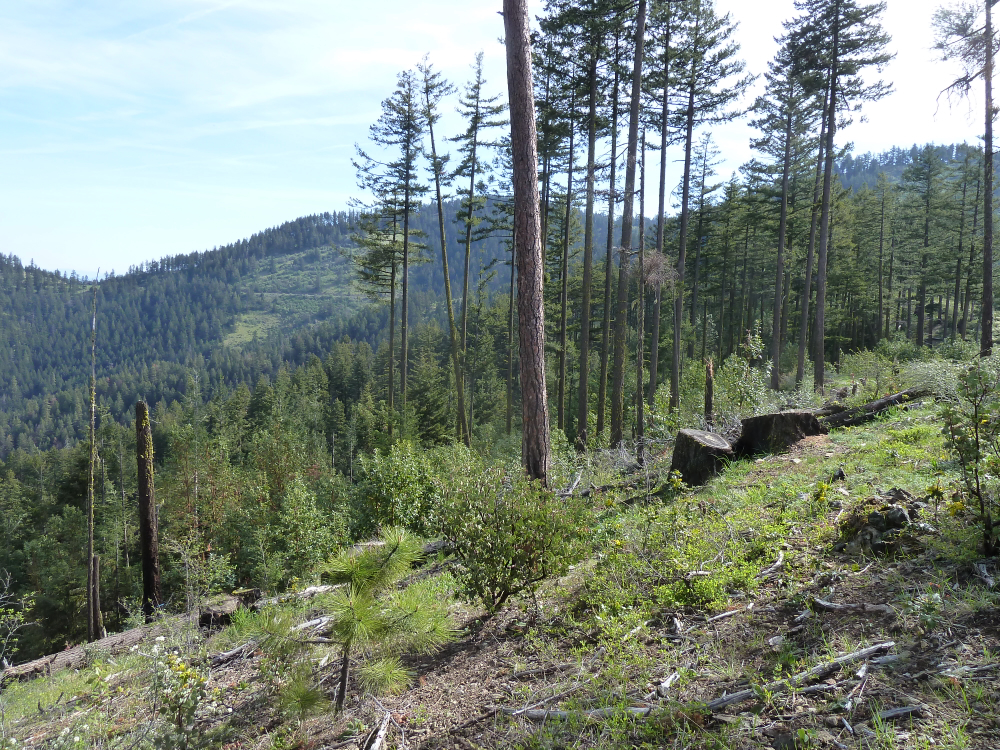
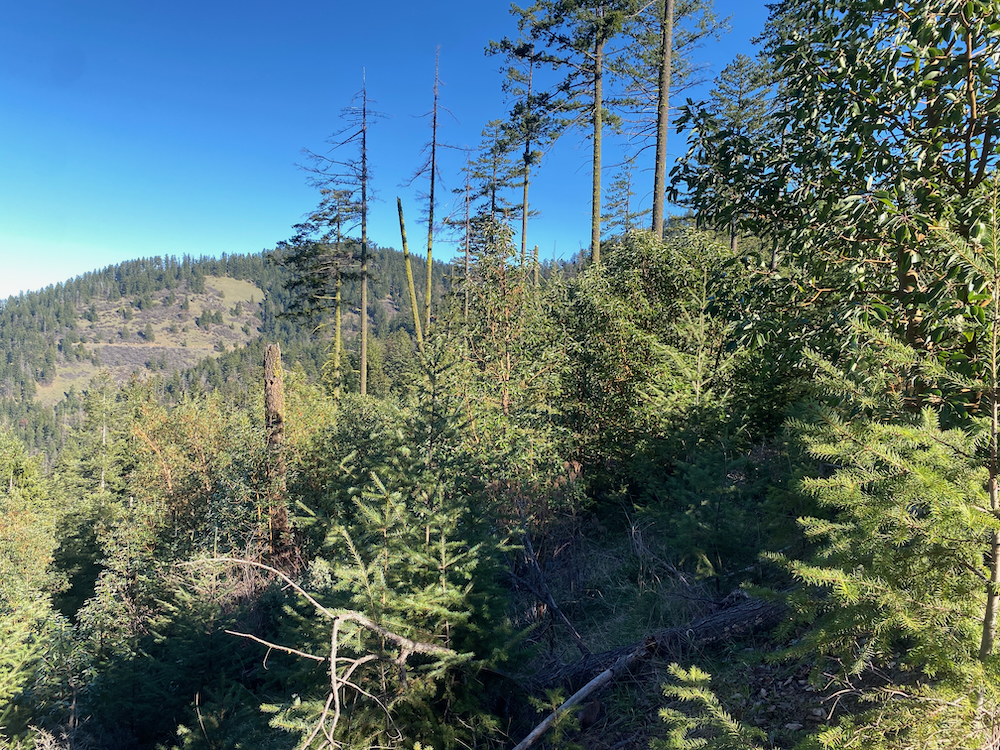
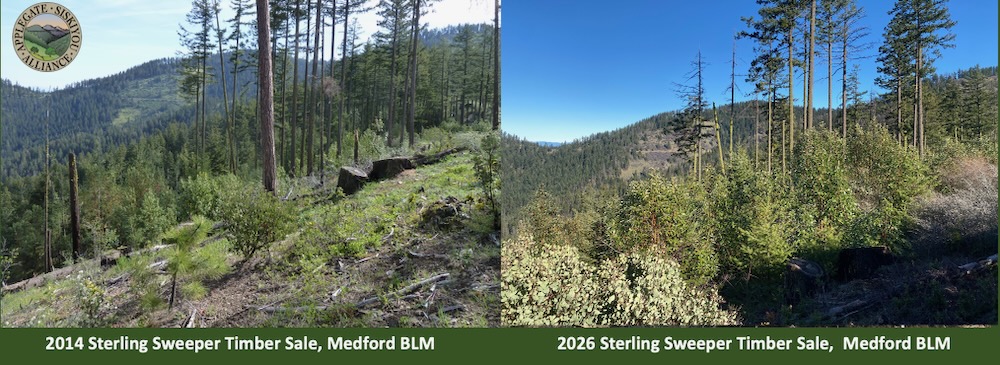
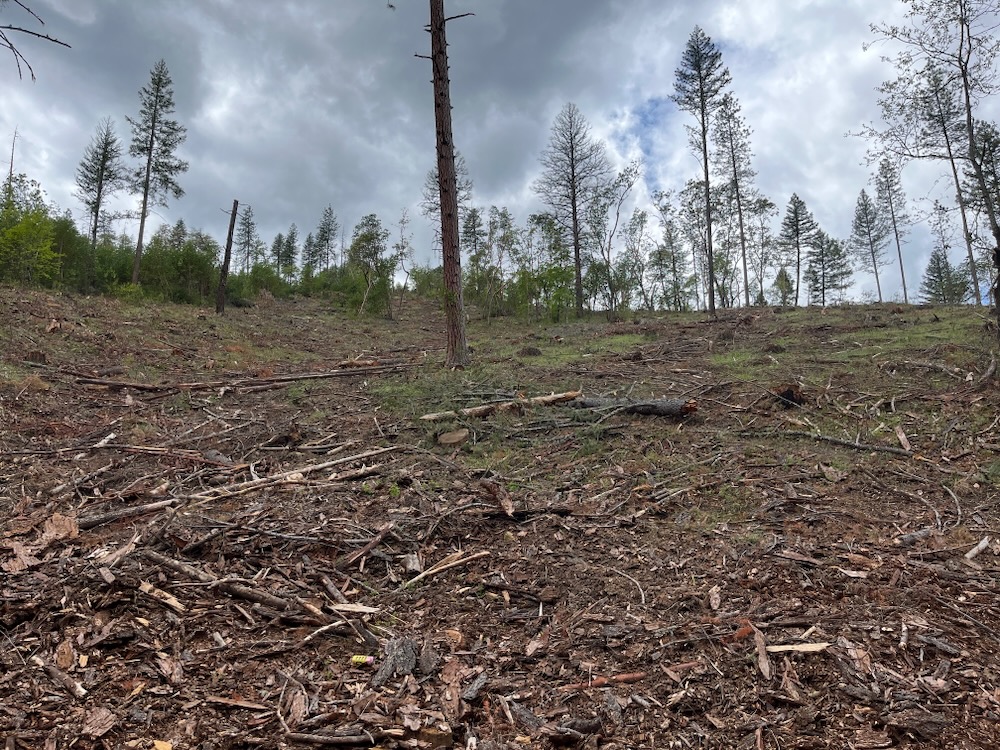
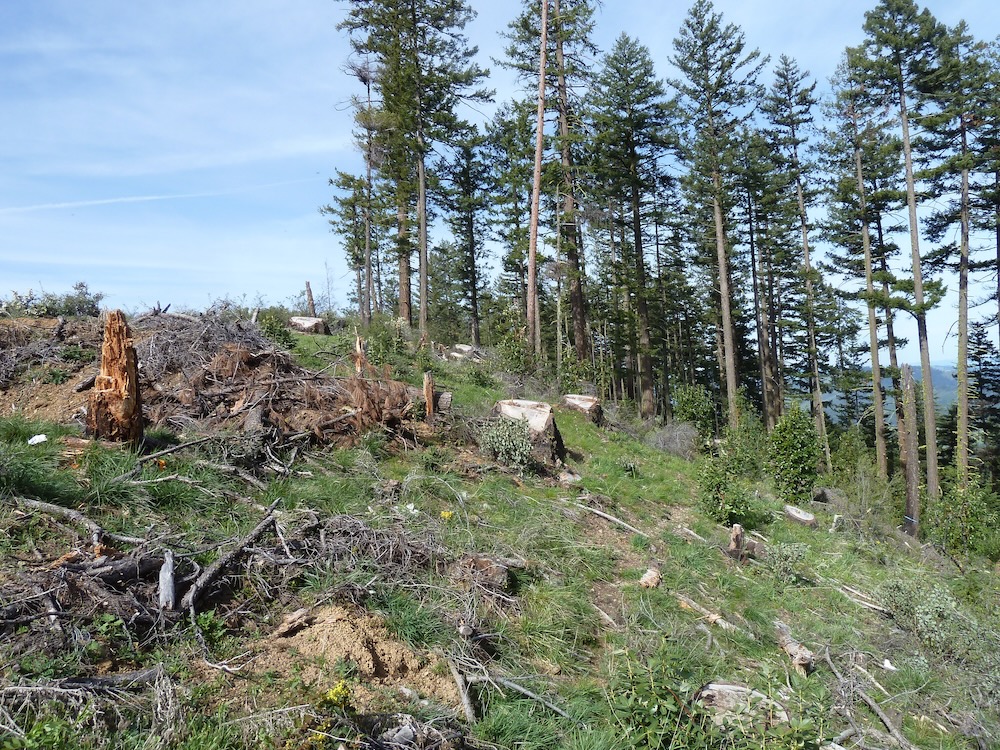
Sterling Sweeper Timber Sale logged 2016.The same location in 2026, after ten years of even-aged regeneration.
The photo on the left was taken in 2016 just after implementation of the Sterling Sweeper Timber Sale on BLM lands above Sterling Creek. Before timber sale implementation, this was a closed stand dominated by Douglas fir and relatively clear in the understory due to canopy shading. The photo on the right shows even-aged young tree and shrub regeneration and fuel development ten years later in 2026. Also take note of the mortality and continued canopy loss following timber sale implementation. The big pine retained at the center of the photo in 2016 has died and fallen over by 2026. At the same time, most of the Douglas fir retained during the Sterling Sweeper Timber Sale have also died, leaving a young, even-aged stand with a few remnant mature trees. This is deforestation and forest degradation that leads to an increase in fire risks and a loss of habitat, it is not forest restoration or fuel reduction.
The BLM is currently attempting to log off as much mature, late successional, and old-growth forest as they they can during the Trump era, under permissive regulatory environments, with as little public involvement or accountability as possible, and, like much of the Trump Administration’s tactics, by using a false narrative filled with misinformation, disinformation and outright lies.
No longer serving the public interest, the BLM is logging off our forests in the Applegate Valley, threatening our communities with increased fire risks, threatening our watersheds and fisheries with increased sedimentation, destroying our viewsheds, hiking trails, and recreation areas, and impacting our local economy by turning once beautiful landscapes into stumpfields and ugly logging scars.
Who wants to come to local vineyards to sip wine and look out over damaged environments and devastated viewsheds? Who wants to hike local trails through logging scars and look out over denuded forest habitats? What does deforestation do to our property values, rural economy, and quality of life here in the Applegate Valley?
How does this logging affect stream flows, fisheries, wildlife, native plant communities, the health of our river, the beauty of our environment, the resilience of our forests, and the pride people feel of living in this spectacular place?
The impact to our region is profoundly negative both to local communities and the natural environment. This Trump era logging will change the Applegate River watershed forever, offering future generations a less vibrant, less beautiful, less abundant environment than we enjoy today.
Butchers, not stewards of the land, the Medford District BLM will take our timber, sell it to the highest bidder (which in this case is not all that high), ravage our mountainsides, and leave our watersheds, forests, and scenic character permanently degraded, heavily impacted, disrespected, and defiled by those we have entrusted to manage our public lands.
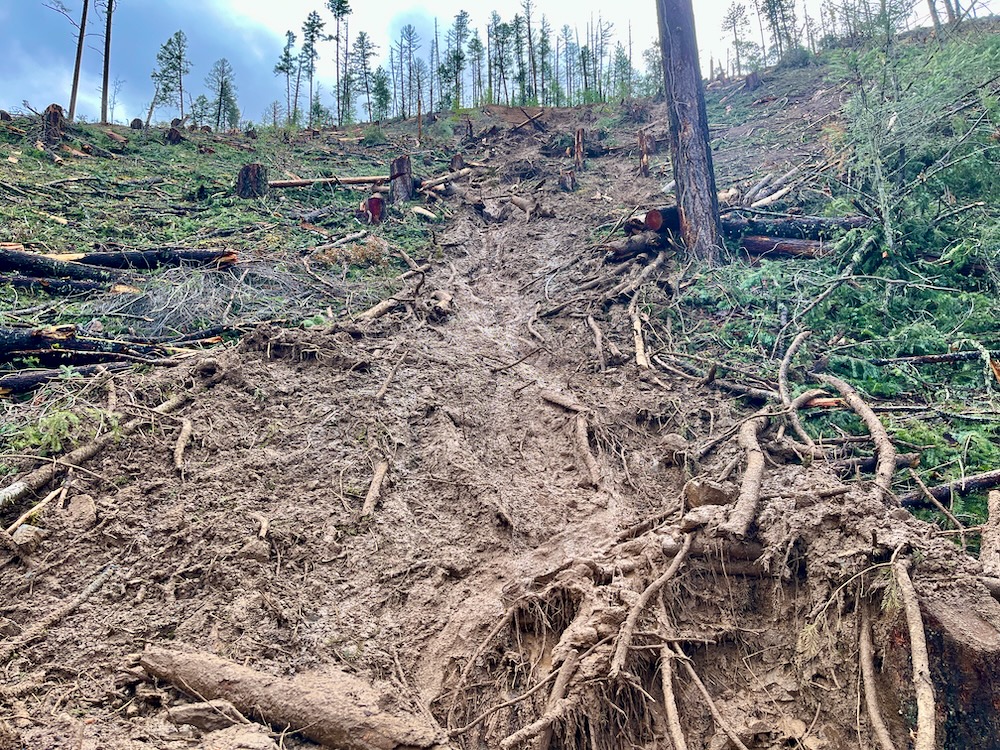
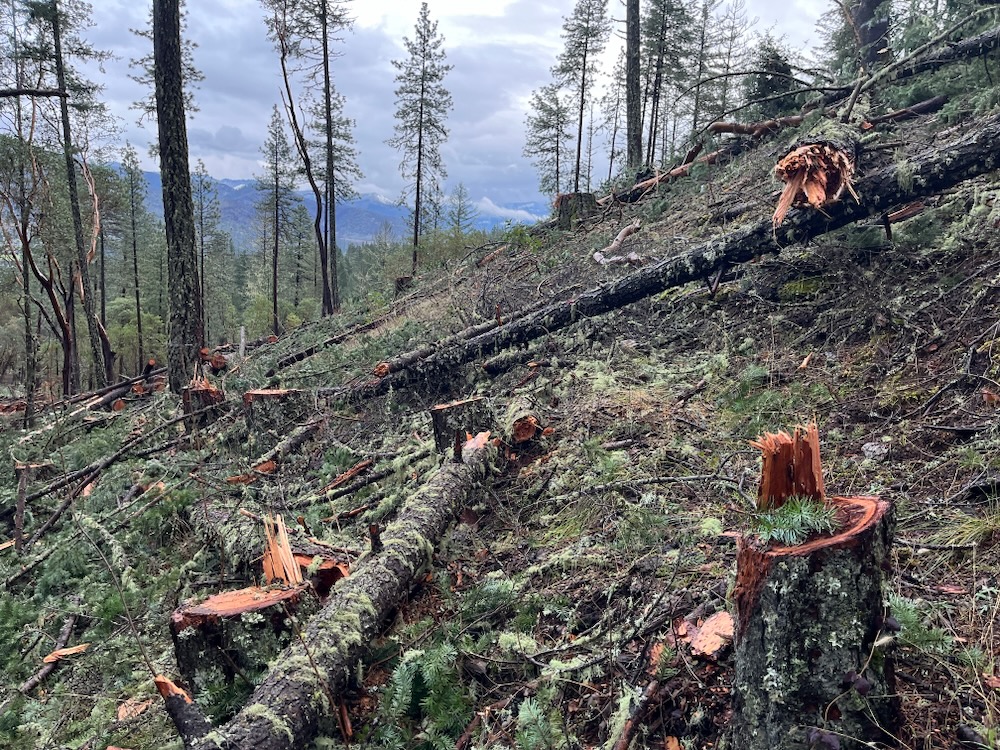
Clearcut logging of live and dead standing trees in the Boaz Salvage Timber Sale led to landslides and debris flows in the Neds Gulch watershed. The BLM claimed this project would have no significant impact, yet created impacts that will take generations to heal.
This rush to log off our public lands is motivated by the greed of industry, the greed and indifference of the Trump Administration and the policies of the Department of Interior, led by Secretary of Interior Doug Burgum, who has identified our public lands as the “balance sheet” of the country. On a local level the BLM has begun that liquidation of assets, by logging off the mature and late successional forest throughout our region.
Collectively, the public land timber sales being implemented and proposed in the Applegate Valley are the biggest threats we have seen on our public lands for many decades. Currently, the powers that be, both on a local and national level have little to no concern for the health of these lands, or our communities.
The logging proposed in the Lone Wolf Timber Sale will not benefit the people, the wildlife, the forests, or the watersheds of the Applegate River watershed. In fact, it will have the opposite affect, sending the profits off to timber companies and investors, while leaving our communities to live with the mess.
The Medford District BLM works everyday to destroy the forests we love with new roads and industrial logging scars. In turn ASA works everyday to oppose the timber sale that threaten the land we call home.
Please join ASA as we work to protect these forests! The future of our region depends on protecting our forests today!
Take Action!
Tell Senators Wyden and Merkley that you want them to help save the forests of the Applegate! Tell them to push back on the Trump Administration’s public lands logging agenda, and to stop the Lone Wolf Timber Sale!
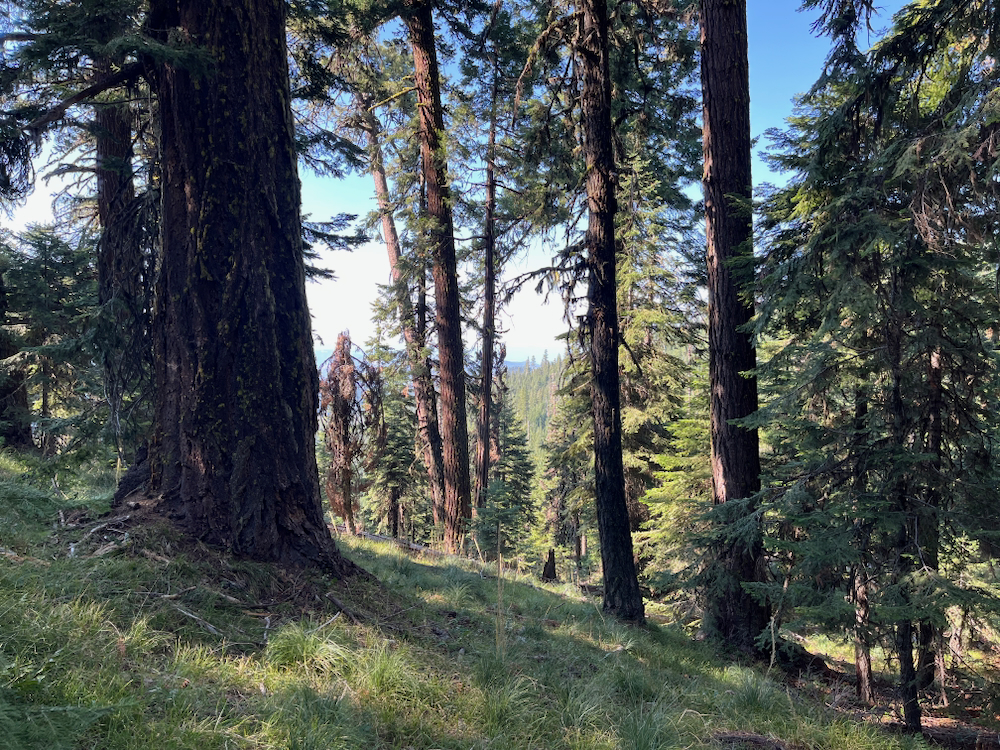
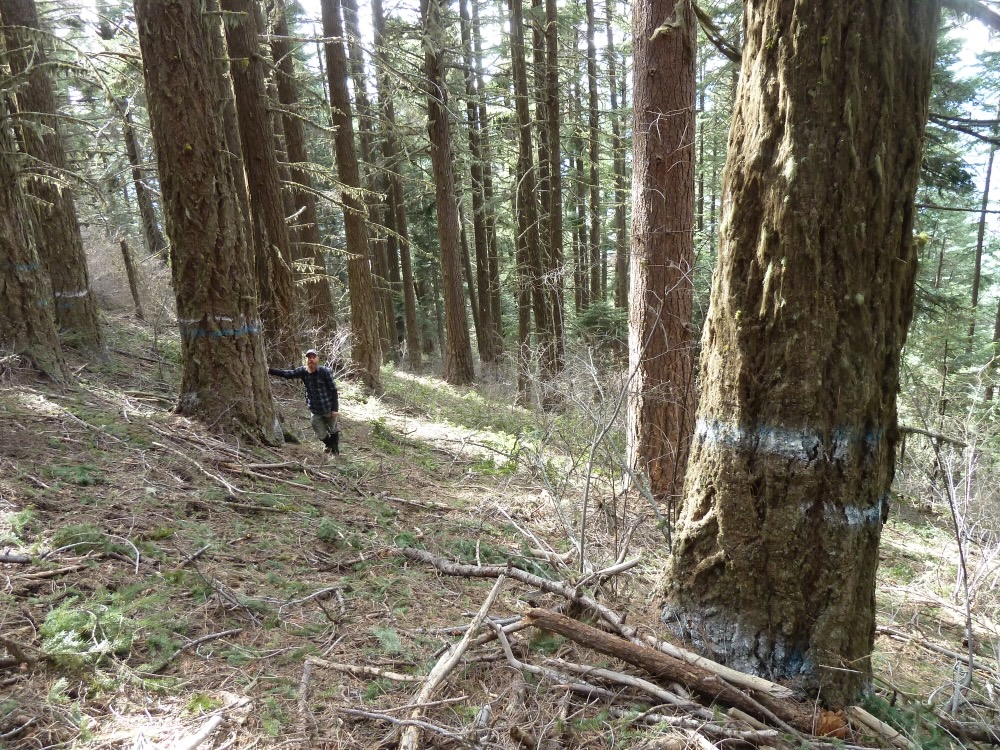
Unit 300 of the Yellowjacket Project is located on the northern face of Yellowjacket Ridge and contains beautiful stands of open-grown, old-growth Douglas fir dominated by large, fire resistant trees.
The Forest Service is proposing a massive project on the Siskiyou Crest, the Yellowjacket Project, that could result in 7-14 different timber sales, at mid to high elevations, across the headwaters of the Applegate River, including old-growth forests.
We will discuss the Yellowjacket Project in detail below, but first, a little bit of background about how it came about. TAKE ACTION at the end of this blog! We may not have much time to comment after their shortened Environmental Analysis comes out, so COMMENT NOW!
Emergency Situation Determinations (ESD) are being used to fast-track logging of public forests
In April 2025, Secretary of Agriculture Brook Rollins issued a Secretarial Memo aimed at increasing timber production on National Forest lands. The agency did so by placing over 112 million acres, approximately 58% of our National Forest lands, including all of the Rogue River-Siskiyou National Forest under an “Emergency Situation Determination” or ESD.
ESDs were intended to address urgent, sudden, or unforeseen threats to public safety or natural resources, but they are now being used to approve large logging projects on federal lands where no urgent threat exists. The intent is to fast-track timber extraction, bypass traditional environmental analysis, cut out public involvement opportunities, reduce transparency, eliminate standard public comment periods, eliminate objection processes, and expedite logging projects on public lands, including the Klamath-Siskiyou Mountains.
Currently, National Forest Ranger Districts across the West are implementing increasingly large and damaging timber sales with increasingly little to no public involvement, little environmental analysis, and virtually no limits on the scope, scale or intensity of logging that can be proposed under ESD timber sales.
For example, in Northern California the Shasta-Trinity and Klamath National Forests are both proposing and authorizing large, landscape scale logging projects throughout wild, rugged and remote lands on the Klamath and Trinity Rivers. These large scale timber grabs propose logging tens of thousands of acres, including Endangered Species habitats, mature, late successional and old-growth forests, forests adjacent to communities, forests above Wild and Scenic Rivers, and forests in backcountry habitats.
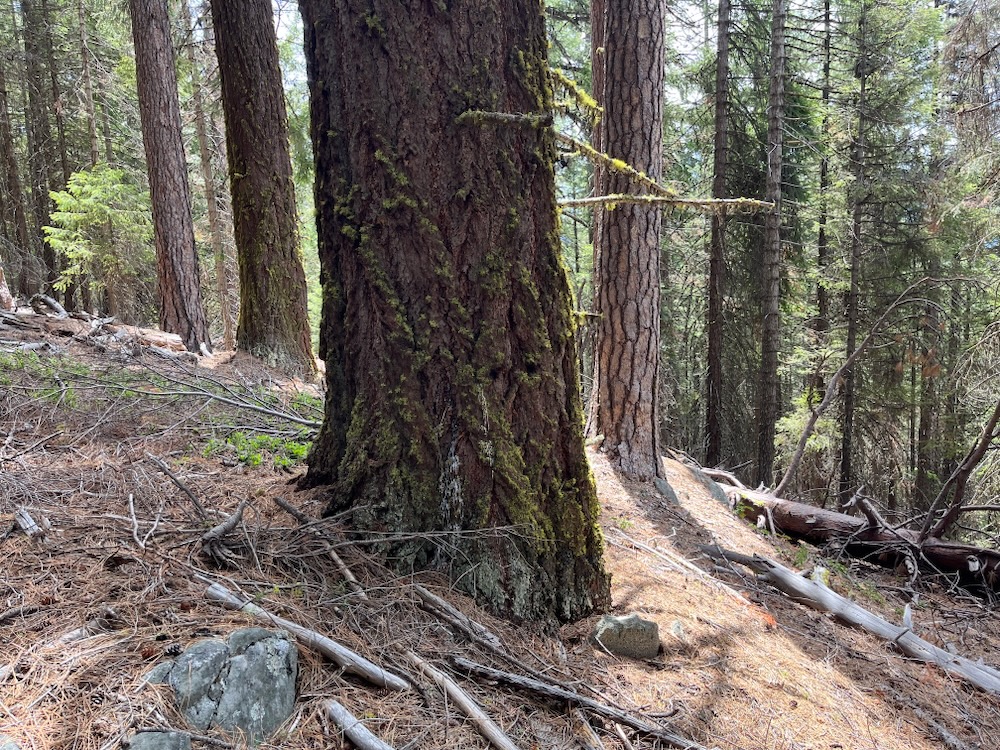
Old forest in unit 282 on the western face of Wagner Butte and below the Wagner Butte Trail is proposed for logging in the Yellowjacket Project. The unit is located either within or directly adjacent to the McDonald Peak Inventoried Roadless Area and contains patches of old-growth and late successional forest.
These projects are being proposed with only a handful of pages of cursory, non-site-specific analysis, a list of Project Design Features (PDFs) to implement, and perhaps a few relatively low-resolution maps, yet they will have long-lasting consequences for the environment across vast swaths of public land.
This is classic, shortsighted Trump Administration policy: declare a national emergency, implement activities without regulatory burden, public oversight, transparency, or accountability, and then use a federal agency you just gutted into submission with mass firings and extreme budget cuts to implement your damaging and unpopular policy.
As usual, this would create massive and immediate profits for industry and monied interests, at a pace that is altogether unsustainable, extremely damaging to the environment, detrimental to the broader public interest, damaging to the surrounding community’s quality of life, and damaging to the agency that is now unpopular for its policy of caving to industry and the administration’s demands to log, mine, graze, or otherwise degrade our public lands for private profits. It is a sad state of affairs on our public lands under the Trump Administration.
The Yellowjacket Project
The north face of Yellowjacket Ridge is proposed for logging in a series of units containing mature, late successional and old-growth forest, like unit 300 which contains beautiful forests, serpentine rock outcrops and grasslands, wet meadows, springs, and headwater creeks that make up Te’el Creek which feeds the popular Acorn Women Lake.
Unfortunately, the Rogue River-Siskiyou National Forest has proposed its first ESD timber sale on the Siskiyou Crest and in a very large portion of the Applegate River Watershed and in the Applegate Adaptive Management Area (AMA), which was designated specifically to facilitate community-based collaboration. Limiting public-facing analysis and reducing public involvement opportunities through the use of an ESD is not consistent with the mandates of the AMA, the National Environmental Policy Act, or the expectations of the public when managing their public lands.
The timber sale project, called theYellowjacket Project, covers thousands of acres of Applegate forests on the western face of Wagner Butte, on Glade Creek, Yale Creek, Crepsy Gulch, Center Ridge and across the headwaters of the Little Applegate River. It also includes Te’el Creek in the Upper Applegate River watershed, along Elliott Ridge, Yellowjacket Ridge and on the slopes of Acorn Woman Mountain above Acorn Woman Lake.
You can expand this map of the project on the Yellowjacket Project page here.
Sprawling across much of the eastern Applegate River watershed, the commercial logging proposed in this project has the potential to permanently damage the forests, scenic viewsheds, habitat values, wildfire resilience, and watershed values of the region. Recent field monitoring has validated these concerns as we are finding mature, late successional and old-growth forests targeted for logging throughout the timber sale area.
This includes old forest habitat on the western slope of Wagner Butte, near the Wagner Butte Trailhead, near the Wagner Butte Trail, on Center Ridge, at the headwaters of the Little Applegate River, and on Greeley Creek, where we have documented Pacific fisher utilizing the proposed logging units.
A pacific fisher documented this summer in unit 278 on the western face of Wagner Butte near Greeley Creek and the McDonald Peak Inventoried Roadless Area. ASA has game cameras set up in key areas of the Yellowjacket project to document wildlife use of the proposed logging units.
Additional commercial logging units have been identified in the beautiful, old-growth forests on the northern slope of Yellowjacket Ridge. At over 5,500 feet in elevation, this area has open forests of Jeffrey pine and Douglas fir that mingle with closed stands of white fir, small mountain meadows and rocky serpentine outcrops.
These old, complex stands are important as climate refugia, for their natural fire resilience, for the biodiversity they sustain, for the unique wildlife they support, and as intact habitats with exceptional biological values. We are concerned that they have been included in the Yellowjacket Project, are proposed for commercial logging, and will be heavily impacted if that logging actually occurs.
Yellowjacket Ridge contains serpentine openings and dry meadows filled with native grasses and wildflowers. The mature, late successional and old-growth forests surrounding these beautiful rocky meadows would be logged in the Yellowjacket Project.
The large tree and canopy reduction logging operations often authorized in public land timber sales can leave stands deficient in structural complexity. By diminishing canopy cover, large tree density, snag habitats, coarse downed wood, and in lower elevations important hardwood components, these forest will take potentially centuries to recover. The removal of large trees and the massive reduction in canopy would make these forests less fire resilient by increasing dense, even-aged understory growth and fuel loading, and by altering microclimates significantly towards, hotter, drier, more windy environments with potential for far more active fire behavior during wildfire event.
The Forest Service is also proposing to implement widespread roadside logging of “dead and dying” trees for up to 500’ from nearly all major National Forest roads in the vast planning area in the headwaters of the Little Applegate River and upper Te’el Creek. Using the same disastrous assumptions that the Medford District BLM has used to devastate living forests in the SOS Project, the Boaz Salvage Timber Sale, the Forest Creek Timber Sale and the Lickety Split Timber Sale in the Applegate Valley, the Forest Service is targeting significant acreage under these linear roadside logging prescriptions.
The Forest Service has proposed logging montane forests like these along the 300 road, which traverses Yellowjacket Ridge. The logging “prescription” justifies removing living trees, by declaring them “dead and dying” through erroneous predictions of future mortality. The only certainty of mortality for many of these trees is if the Forest Service approves this form of destruction, irresponsible logging, and declare very much living trees dead, and sells them off to the timber industry.
These logging prescriptions are not only damaging to the land, but they would be misapplied in forest types and habitats where no so-called “Douglas fir decline spiral” currently exists, where the risk of such a mortality outbreak is relatively low, and where stands are dominated or co-dominated by species other than Douglas fir.
Similar roadside “dead and dying” logging prescriptions have been implemented as heavy industrial and clearcut logging on nearby BLM lands. In the Yellowjacket Project this logging would impact old, intact, living forests, habitats with minimal recent mortality, and highly diverse landscapes that currently represent climate refugia, sustain high levels of biodiversity, and provide important habitat connectivity.
According to agency staff, this project could produce between 7 and 14 large timber sales, depending on what is ultimately approved and what units are ultimately moved forward into a final decision. This level of harvest, combined with the current BLM logging frenzy in the foothills of the Applegate would permanently alter our beautiful watershed and dramatically increase fire risks in the mountains that surround our communities.
Prescribed fire would better meet the agency’s fuel reduction goals and ASA supports the burn blocks proposed east of Applegate Reservoir in the Yellowjacket Project.
Currently, the Forest Service appears unsure as to whether it will provide the public with adequate comment opportunity on the Yellowjacket Project. They have said they may not provide a comment period at all, and if they do it might not even be a 30 day comment period. This unwillingness to commit to the typical 30-60-day comment period is unacceptable for a project of this size and scale in high profile areas on the Siskiyou Crest. The Forest Service is also saying the analysis for this massive, sprawling timber sale, that includes much of the Siskiyou Mountains Ranger District, will be capped at a paltry 15 pages, meaning virtually none of the relevant issues will be properly considered or analyzed in the upcoming Environmental Analysis (EA).
Stand conditions in unit 284 of the Yellowjacket Project on the western face of Wagner Butte below road 22 contain relatively open, mid to late successional stands of pine and fir.
The Rogue River-Siskiyou National Forest is currently in the process of planning one of the largest Applegate Valley timber sales in many decades, and they are being pushed by the administration in DC to log off our public lands without properly considering the impacts, providing meaningful public involvement, or public comment opportunities.
Our forests, our wildlands, and our communities deserve better, and what is being lost simply cannot be restored. It’s now or never on our public lands. The last uncut forests, wild rivers, and scenic mountain ranges are being offered to extractive industries for logging, mining, gas drilling and other forms of development. It’s time for the public to push back on both a national and local scale, and demand that these lands be managed for both the public interest and future generations, not short-term profits that leave our communities, watersheds, and forests less resilient, less vibrant, less livable, and less beautiful.
Although the Rogue River-Siskiyou National Forest may or may not be offering a public comment period for this vast and important project, they have indicated they are open to receiving comments and incorporating them into the public record for the Yellowjacket Project. We encourage you to send them an email now with your comments on the Yellowjacket Project.
We also hope they are willing to alter this project, cancel the mature, late successional and old-growth units, build no new roads, and focus on management that serves, rather than harms the public interest in these spectacular public lands.
With this in mind, we are initiating our own public comment period and encouraging people who care about the public forests of the Siskiyou Crest to reach out to Forest Service officials and demand that they protect our last old forests, and implement management activities that will make our forests more, not less healthy, resilient and biologically diverse.
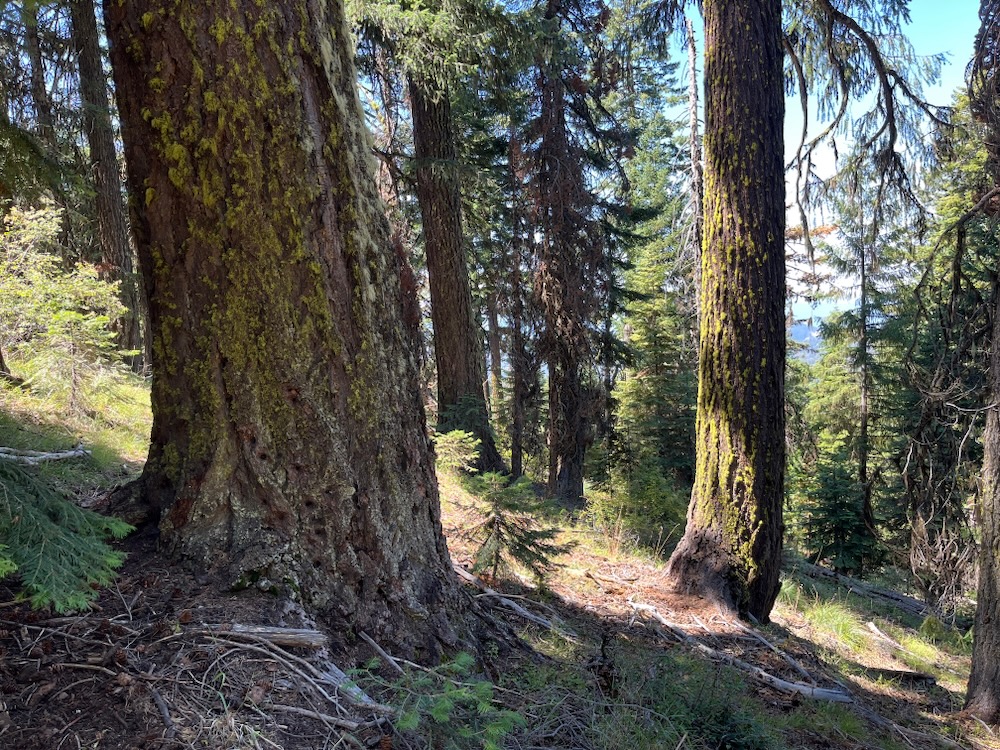
Unit 290 of the Yellowjacket Project is located on Center Ridge near the headwaters of the Little Applegate River and contains some truly spectacular trees, like this old Douglas fir. Although large portions of the stand have been previously logged, many large, old-growth trees remain in the stand and ASA will advocate for the retention of all large trees in the Yellowjacket Project Area.
Take Action
Click the button below to send a letter to Rogue River-Siskiyou National Forest Supervisor Molly Juillerat, Rogue River-Siskiyou National Forest Deputy Supervisor Paul Simas, U.S. Senator Ron Wyden, and U.S. Senator Jeff Merkley, asking the Forest Service to provide a thorough Environmental Analysis of this massive logging project, a full 30-60-day comment period, and NO logging of mature and old-growth forests.
A 15-page Environmental Analysis and shortened comment period is not acceptable for this size of a project on our public lands!
The Emergency Situation Declaration (ESD) is inappropriate. There is no credible emergency and no excuse for cutting public comment and scientific analysis out of the process.
The Forest Service must conduct a thorough and well-developed Environmental Analysis that provides extensive site-specific information, the disclosure of project level and cumulative impacts, and a backing in credible science.
Provide a full 30-60-day public comment period on the Environmental Analysis.
Remove all mature, late successional and old growth forests from the commercial timber sale area withdrawing the following units near Wagner Butte, Center Ridge, the headwaters of the Little Applegate River and on Yellowjacket Ridge. Unit 270, 278, 281, 282, 283 and 284 near Wagner Butte, unit 300 on Yellowjacket Mountain, and the mature forest portions of unit 274 above the Little Applegte River.
Cancel all logging units in Nesting, Roosting and Foraging habitat for the northern spotted owl and all logging proposed in Riparian Reserves.
Maintain all dispersal habitat for the northern spotted owl and implement treatments that will help develop late successional habitats.
Focus thinning treatments only in plantations and young stands with a history of industrial logging. Repair the damage from previous clearcut, high-grade, and industrial overstory logging practices, and do not create new industrial logging impacts in previously unentered land.
Large, overstory trees and complex forest are deficient throughout the planning area due to historic logging. Retain all large trees over 20” diameter throughout the planning area. This will ensure that adequate large living trees, canopy cover, current stand complexity, and future snag and downed wood recruitment is maintained.
Retain a minimum of 50% canopy cover in logging units to reduce the aggressive understory woody fuel and fine fuel response associated with gap creation and canopy cover reduction.
Build no new roads (temporary or permanent) and no new log landings.
Do not implement so-called “dead and dying” salvage logging. The practice is environmentally damaging and inappropriate in the planning area. No significant flatheaded fir borer mortality has occurred in the planning area
Cancel all roadside dead and dying salvage units and implement only true hazard tree removal along well used BLM roads.
Support the Forest Service’s large prescribed fire units or “burn blocks” east of Applegate Reservoir in the project.
TAKE ACTION &COMMENT NOW ON THIS TRUMP ADMINISTRATION PROPOSAL TO RESCIND ROADLESS AREA PROTECTIONS NATIONWIDE. SAY NO TO LOGGING, MINING AND ROAD CONSTRUCTION ON OUR MOST PRECIOUS PUBLIC LANDS!
With the Trump Administration proposing to eliminate the vital protections provided by the 2001 Roadless Rule, we need your help to stand up, speak out and help us protect the most important wildlands in both the Applegate River watershed, and throughout Forest Service lands nationwide. Roadless Areas represent some of the best examples of intact, non-industrialized land in the country, and their protection is at the heart of any credible conservation effort.
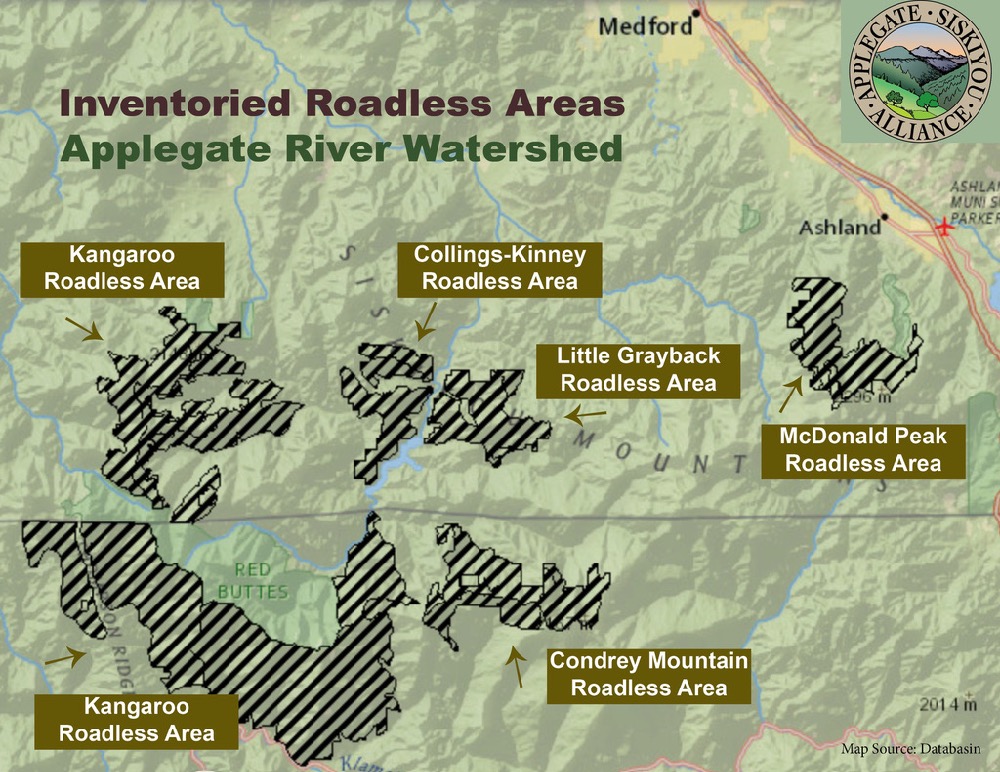
Below are descriptions of the six Inventoried Roadless Areas in the Applegate River watershed. All would lose protection under the Trump Administration’s proposal to rescind the protections of the 2001 Roadless Rule. The six Inventoried Roadless Areas, located at least partially within the Applegate River watershed, include habitats at both low and high elevation, in the ancient forests of the region, along intact tributary streams, in beautiful oak woodlands, arid grasslands, chaparral habitats, high mountain meadows, and in the rocky high country of the Siskiyou Crest.
Below is a small sample of each Inventoried roadless area in the Applegate River watershed and a few of their important attributes:
Little Grayback Inventoried Roadless Area
The Little Grayback Inventoried Roadless Area from the Little Grayback Trail. The snow capped peaks in the distance are a portion of the Condrey Mountain Inventoried Roadless Area.
The Little Grayback Inventoried Roadless Area is located in the foothills of the Upper Applegate River watershed and above the pastoral Upper Applegate Valley. The region contains multiple popular recreational trails, including the Mule Mountain, Mule Creek, Baldy Peak, and Little Grayback trails, and spectacular low elevation foothill habitat. The area includes Mule Mountain, Baldy Peak, Little Grayback Mountain, and the southern flanks of Acorn Women Peak, as well as the majority of the Mule Creek watershed, Doe Hollow, Slickear Gulch, and Lyman Creek.
The Little Grayback Roadless Area also includes some of the most important deer winter range in the Applegate River watershed, and perhaps the region’s largest black tailed deer populations. It also includes very diverse and rich plant communities with exceptional botanical values, numerous rare plant populations, mature and old-growth mixed conifer forests, ancient oak woodlands, intact chaparral habitats, small serpentine outcrops, exceptional spring wildflower displays, and incredible views across the Applegate Siskiyou region.
The Lyman-Doe Hollow Botanical Area is also located within the Little Grayback Inventoried Roadless Area.
Collings-Kinney Inventoried Roadless Area
The Collings-Kinney Inventoried Roadless Area from the headwaters of Billy Gulch looking east across the Upper Applegate Valley to Mule Mountain and Little Grayback Moutain in the Little Grayback Roadless Area. .
The Collings-Kinney Inventoried Roadless Area includes Collings Mountain, Kinney Mountain and Billy Mountain, along with numerous small streams, including Grouse Creek, portions of Kanaka Gulch, Buck Gulch, Kinney Creek, and Billy Gulch.
The area supports a diverse mosaic of vegetation, including dry mixed conifer forests, deciduous oak woodlands, live oak woodlands, madrone groves, chaparral, knobcone pine groves, and generally very steep, rugged habitats above the Upper Applegate Valley, Applegate Reservoir, and Carberry Creek. The popular Collings Mountain Trail and Grouse Loop Trails extend throughout the area, providing access to both the intact habitats of the Collings-Kinney Roadless Area and the famous bigfoot trap on Grouse Creek near the Applegate Reservoir.
Kangaroo Inventoried Roadless Area
At over 90,000 acres the Kangaroo Inventoried Roadless Area surrounds the rugged Red Buttes Wilderness at the headwaters of the Applegate River and along the Oregon-California border. The sprawling roadless area includes vast swaths of old-growth mixed-conifer and montane forest on the northern flank of the Siskiyou Crest, including the over 35,000-acre Oregon-Kangaroo Roadless Area and the over 60,000-acre California-Kangaroo Roadless Area.
Oregon-Kangaroo Inventoried Roadless Area
The Oregon-Kangaroo Inventoried Roadless Area divides the Applegate from the Illinois River watershed and contains both rocky high country and vast old-growth forests in the lands between the Red Buttes Wilderness, Oregon Caves National Monument and Grayback Mountain.
The Oregon-Kangaroo Roadless Area contains the backcountry surrounding the Oregon Caves National Monument and lands directly north of the Red Buttes Wilderness Area.
Dividing the Applegate from the Illinois River drainage, the tall ridge system known locally as the Grayback Range, is known for its lush ancient forests, moist mountain meadows, beautiful headwater streams, and tall mountain peaks, including Grayback Mountain, Sugarloaf Peak, Craggy Mountain, Mt. Elijah, Swan Mountain, Arnold Mountain, Steve Peak, and Iron Mountain. It also includes the Craggy Mountain Scenic Area, the Grayback Botanical Area, the Hinkle Lake Botanical Area, and the Oliver Matthews Research Natural Area, as well as the headwaters of Sucker Creek in the Illinois River watershed, Carberry Creek and Williams Creek in the Applegate River watershed.
The area is accessible from the incredibly scenic Boundary National Recreation Trail, which links together the popular O’Brien Creek, Sturgis Fork, Elk Creek, Miller Lake, Limestone Gulch, and Grayback Mountain Trails. This trail system connects the Oregon Caves National Monument with the Red Buttes Wilderness and the Pacific Crest Trail.
California-Kangaroo Inventoried Roadless Area
Fire adapted old-growth forest in the California-Kangaroo Inventoried Roadless Area on the Butte Fork Applegate River.
The California-Kangaroo Roadless Area surrounds the spectacular Red Buttes Wilderness Area with over 60,000 acres of intact, highly diverse roadless habitat. These exceptionally steep, rocky and scenic wildlands extend from the summit of the Siskiyou Crest, and reach into both the headwaters of the Applegate River, as well as south virtually to the banks of the Klamath River.
The northern slopes draining the Butte Fork and Middle Fork Applegate River watersheds contain vast old-growth forests and intact watersheds like Lick Gulch, Cook and Green Creek, and Echo Creek along the popular Cook and Green Creek, Butte Fork, and Horse Camp Trails, as well as portions of the Middle Fork National Recreation Trail. The summit of the Siskiyou Crest in this section is rugged, rocky and remote, while Cook and Green Pass and the Cook and Green Pass Botanical Area have been documented as one of the single most diverse aggregations of native plants in California.
In many places, the southern slopes drop undisturbed from the Siskiyou Crest to Highway 96 and the Klamath River. The area includes over 13 miles of the Pacific Crest Trail. It also includes the upper Seiad Creek watershed, along with Canyon, Portuguese, Fort Goff, and upper Thompson Creek. The upper portions of the Roadless Area border the Red Buttes Wilderness Area and are accessible by the Boundary National Recreation Trail which traverses the spine of Siskiyou Crest between Cook and Green Pass and Lonesome Lake.
The Seiad Baker Cypress Botanical Area is located within the California-Kangaroo Roadless Area. The area supports one of only eleven populations of Baker’s cypress in the world and is also one of the most healthy populations of this rare conifer species. Most of the area is also designated as a Backcountry Area on the Klamath National Forest
Condrey Mountain Inventoried Roadless Area
The Condrey Mountain Inventoried Roadless Area and Alex Hole from near the Pacific Crest Trail looking north into the Elliott Creek watershed.
The Condrey Mountain Inventoried Roadless Area is located east of Cook and Green Pass and west of Big Rock on the Siskiyou Crest. The over 9,000-acre Roadless Area contains extensive old-growth forests and clear-flowing streams in the Elliott Creek, Dutch Creek, Studhorse Creek, Alex Creek and Middle Hell Watersheds. The upper portions of the roadless area are accessible by approximately 15 spectacular miles of the Pacific Crest Trail which traverse montane forests, high mountain meadows, diverse botany, and unique schist geology.
The area includes portions of the Cook and Green Pass Botanical Area, the Scraggy Mountain Botanical Area, and the White Mountain Botanical Area, as well as portions of the Condrey Mountain Blue Schist Geologic Area. The Condrey Mountain Inventoried Roadless Area is one of the Applegate’s most forgotten gems and is highly important for habitat connectivity.
McDonald Peak Inventoried Roadless Area
A view across the McDonald Peak Inventoried Roadless Area and the Little Applegate River watershed from near Wagner Butte.
The McDonald Peak Inventoried Roadless Area is located at the headwaters of the Little Applegate River high on Wagner Butte, Split Rock and McDonald Peak. It also extends into the Ashland watershed below Mt Ashland. The area includes some of the highest elevation habitats in the Siskiyou Mountains, along with dense old-growth forests, disjunct and unusual conifer species, lush mountain meadows, large aspen glades, sagebrush clearings, and mountain mahogany groves.
The McDonald Peak Inventoried Roadless Area also includes portions of the Mt. Ashland-Siskiyou Peak Botanical Area and creates the headwaters of the Ashland Creek watershed, which provides municipal water for the city of Ashland. Important for recreation, the area includes the highly popular Wagner Butte, Wagner Glade, and McDonald Peak Trails, which connect to the Pacific Crest Trail and the nearby Grouse Gap Snow Shelter, as well as the Ashland Trail System leading from the Siskiyou Crest to community of Ashland.
As the saying goes, “roadless is priceless” and these last intact gems should be preserved in perpetuity, not degraded for the short-term profits of the timber and mining industry. The Trump Administration has proposed eliminating protections for these roadless areas by revoking the 2001 Roadless Rule. Please help us fight like the last wildlands depend on it, because they do! Don’t let the Trump Administration whittle away the last wildlands in the country!
Below is comment information are two ways you can both support the protection of roadless areas and push back against attempts to remove roadless area protections:
Comment on the Trump Administration’s Attempt to Rescind the 2001 Roadless Rule
Roadless Area protections should be strengthened and expanded rather than be rescinded.
Support no logging or road construction in Roadless Areas nationwide.
Prohibitions in Roadless Areas should include a ban on motorized trail use in all Roadless Areas nationwide.
Logging is not a solution to either fires or forest health concerns, and can, in many situations, make fires burn with more intensity due to microclimate alterations, the loss of large fire resistant trees, and a significant response from woody understory shrub species.
Road construction in currently unroaded lands is detrimental to fisheries, water quality, native plant communities, wildlife and wildfire risks, by increasing stream sedimentation, spreading noxious weeds, and creating opportunities for increased human ignitions.
The 2001 Roadless Rule was responsible, reasonable, and important for the maintenance of both biological values and local economies where roadless areas play a significant role in the outdoor recreation economy, provide important ecosystem services, and promote a high quality of life in surrounding communities.
America’s love their public lands and support their protection. In fact, 99% of the comment received by the Forest Service over the current Roadless Area Revision proposals have opposed the removal of these protections!
Support the Roadless Area Conservation Act!
Talking points:
Ask your elected officials to support and even cosponsor the Roadless Area Conservation Act. You can email Congressman Cliff Bentz here. Senators Jeff Merkely and Ron Wyden are already cosponsoring the bill, which is great, and you should thank them for sponsoring it! Or if they aren’t your represenatives or senators, click here to find contacts for your senator, or here to find contacts for your representative.
Let them know how important these wildlands are for wildlife, watersheds, biodiversity, fire resilience, recreation, and even economic values.
Let your elected officials know you love roadless wildlands and are outraged by the Trump Administration proposal to rescind the 2001 Roadless Rule.
Ask them to continue and more aggressively support the permanent protection of Roadless Areas through the Roadless Area Conservation Act.
Contact your elected officials and ask them to support either the Senate or Congressional version.
Roadless is priceless. Check out this drone footage of the Kangaroo Inventoried Roadless Area at the headwaters of the Applegate River!
It may seem obvious, but logging kills trees. If drought and insects are already killing Douglas-fir trees, why does the BLM want to kill more?
When compared to other areas on Ben Johnson Mountain, Douglas-fir tree mortality has been the highest on the eastern face of the mountain, where BLM logged off whole stands of living Douglas-fir trees in the Apple Saws Timber Sale. Although identified as “salvage” logging, the Apple Saws Timber Sale targeted mostly living stands of trees and virtually clearcut them. The timber sale logged thousands and thousands of living, green, viable trees under the BLM’s false “dead and dying” narrative.
The Medford District BLM has released the aptly named Douglas Fir Mortality Complex, a sprawling Applegate Valley timber sale of epic proportions.
Information about how to TAKE ACTION is at the end of the blog!
Logging green, living Douglas-fir trees = BLM created Douglas-fir tree mortality
With the influence of climate change, recent heat domes, and flat-headed fir borer beetes, Douglas-fir trees have died in the Applegate Valley and throughout southwest Oregon. This is a just reality, however, in many locations, the process is naturally rejuvenating oak woodlands, creating habitat diversity, and supporting habitat complexity across the landscape. Unfortunately, BLM now wants to log both the trees that died in recent mortality events that are providing exceptional wildlife habitat, and many of the last living, green, Doug-fir/mixed conifer forests left on BLM lands in the Little Applegate River, Sterling Creek, and Upper Applegate River watersheds.
In these portions of the Applegate River watershed, plant communities are already shifting in response to climate change, and Douglas-fir trees are already dying on harsh and arid sites below 3,500′ in elevation and in areas with minimal rainfall. The BLM’s response is the Douglas Fir Mortality Complex logging project, which intends to log off the area’s biological legacies (snags) and thousands of acres of forested refugia habitat that survived recent mortality outbreaks. These forests and trees demonstrated relatively high levels of drought and beetle resilience; however, BLM intends to log these forests, leaving only scattered, exposed trees and more harsh, sunbaked, windswept, and arid habitat conditions.
The Douglas Fir Mortality Complex project would log over 4,000 acres of forest and build up to 6.7 miles of new permanent road, scarring the beautiful Siskiyou Mountains surrounding the Applegate Valley, as well as the Lake Creek and Little Butte Creek areas east of Medford in the foothills of the Cascade Mountains.
In the Applegate Valley, the logging proposed would degrade forest habitats throughout the eastern portions of the Applegate Valley on lower Yale Creek, Sterling Creek, above Griffin Lane, in the Little Applegate River canyon, above the Little Applegate Valley and Buncom, up Grouse Creek, and on the flanks of Cinnabar Ridge. The logging would also impact Boaz Mountain , large areas above Eastside Road and lower Star Gulch in the Upper Applegate Valley.
Trillium Mountain seen here from the Sterling Ditch Trail would be heavily logged in the Douglas Fir Mortality Complex project, impacting one of the last unroaded and unlogged habitats in the Little Applegate Valley and damaging the scenic qualities of the trail.
The proposed logging would create Douglas-fir mortality like the Applegate has not seen since the days of clearcut-and-run public land logging that extended from the 1950s into the early 1990s. Like these previous timber sales, the Douglas Fir Mortality Complex would leave a lasting impact on the Applegate landscape by creating heavily disturbed stump fields filled with logging slash, highly flammable non-native annual grasses, noxious weeds, churned forest soils, denuded slopes, and within a few years, dense regenerating forests choked with young trees, brush, sprouting hardwoods and abundant fine fuels.
The patchwork of industrially logged habitats, newly constructed roads, historic clearcuts, and open, arid, windswept logging sites would dramatically increase fire risks, damage the scenic viewsheds of the Applegate Valley, degrade water quality, impact important wildlife habitats, and convert currently relatively resilient forest into simplified, early-seral habitats and semi-permanent shrub fields. The result would be to create conditions that tend to burn hotter, faster and with more burn severity than the closed forest stands they would convert through logging.
The process is simple and evident to anyone who has managed forests or woodlot in southwest Oregon, and to anyone who has spent time in the forests and mountains of the region. Yet it is somehow ignored by BLM timber planners and fire/fuel specialists. When forest canopy cover is dramatically reduced, dense, young, highly flammable plant communities and woody vegetation tend to regenerate and dominate for multiple decades following significant canopy and large tree logging operations.
According to BLM’s previous analysis of canopy reduction logging, “For the first 1 to 5 years after harvest, these stands would remain a slash fuel type until the shrubs, grasses, and planted trees become established. After the establishment of regeneration, these stands would move into a brush fuel type. Brush fuel types are more volatile and are susceptible to high rates of fire-caused mortality. Stands could exhibit higher flame lengths, rates of spread, and fire intensity. Fires started within these stands could be difficult to initially attack and control. For 5 to 20 years following planting, the overall fire hazard would increase in these stands.” (Clean Slate Timber Sale EA P. 192).
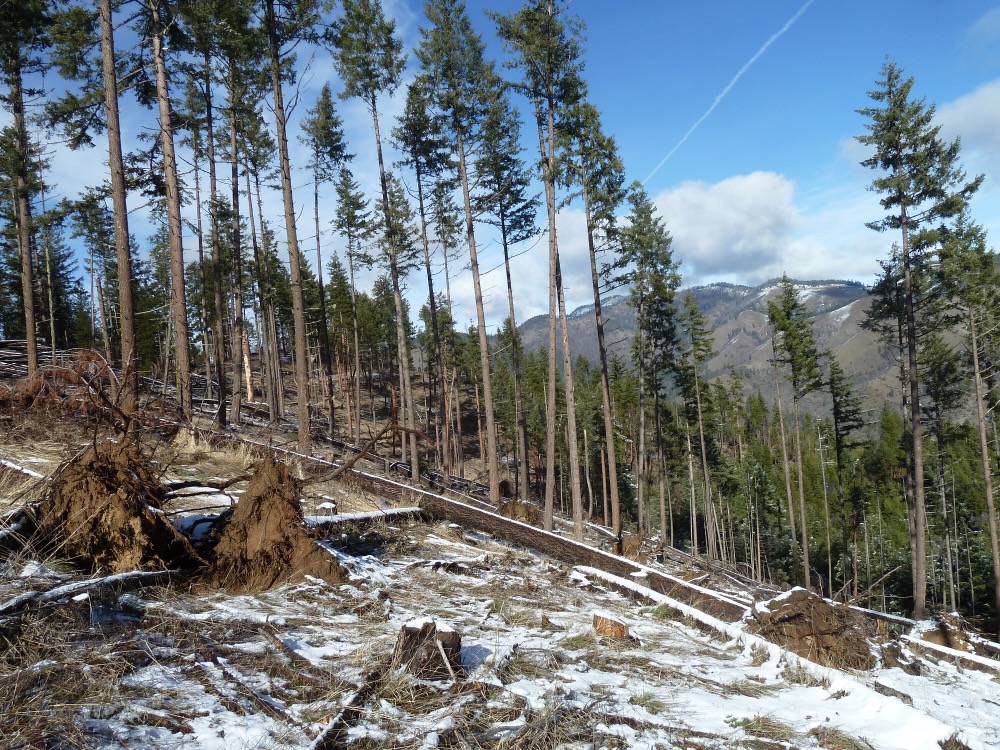
Group selection logging took place in 2014 on the Sterling Sweeper Timber Sale, which logged the majority of the mature trees in the stand and dramatically reducing canopy cover. Twelve years later, in 2026, the large pine at the center of the photo has died and fallen over, while mortality has worked through some of the fir trees retained in the background. Today dense, young, high flammable woody vegetation dominates the site and is decades away from any level of fire, climate or drought resilience. Group selection logging leads to more Douglas-fir tree mortality.
Implementation and On-the-Ground Results Matter More than the False Claims in the BLM’s Environmental Analysis
The BLM can conduct computer modeling simulations all it likes, but it does not change the physical realities on the ground. The BLM can simulate imaginary forests, run imaginary scenarios in its computer modeling programs, identify imaginary growth rates, and predict imaginary outcomes, all to claim a benefit to localized fire risks and a reduction in fuel loading; however, these computer models specifically do not include the abundant understory regeneration that occurs after logging operations, or its influence on stand level fire risks over time. This failure to analyze or model for young regenerating vegetation eliminates the single largest factor influencing future fuel development and long-term fire risks in the BLM’s Environmental Analysis and skews the analysis.
In fact, BLM modeling has consistently failed to match the realities on the ground or the repeated outcome of real-world, BLM timber sales. Timber sales recently implemented by the Medford District BLM are having far fewer positive effects than BLM modeling might suggest, and in many cases are instead reducing forest health, increasing vulnerability to drought and climate related impacts, increasing fire risks, slowing tree growth, introducing significant stress, compounding mortality events, and reducing these forest’s habitat value.
Unfortunately for the BLM, and for the public, the results of their recent logging operations are written across the landscape, in the form of gaping, denuded slopes, where vibrant green forests and diverse snag patches once stood. The most recent timber sales have steadily converted thousands of acres of mature, closed canopy forest habitats with little understory growth, into non-native annual grasslands, shrub fields, and young, highly flammable vegetation types.
The result is not to reduce mortality risks in the future, but to create mass mortality in the here and now, by logging up 80% of a given stand in habitats with as little as 10% mortality and by logging living trees that survived the recent beetle mortality outbreaks.
No matter how you look at it, BLM is adding to the mortality on the landscape and reducing forested acreage on a landscape scale. This logging is actively expanding and extending the mortality across the landscape, while creating conditions conducive to future mortality and habitat loss.
The Lickety Split Timber Sale logged thousands and thousands of living, green trees to create gaping holes in the otherwise still green forests of the Little Applegate River canyon. These stands contained living hardwood trees, living conifer trees and complex habitats colonized by both large, living trees and standing snags before logging took place. They can now only be described as public land clearcuts.
BLM Timber Sales Lead to Deforestation and Habitat Destruction
Recent BLM timber sales like the Lickety Split, Boaz Salvage, Forest Creek Salvage, Apple Saws and Holcomb Hollow Timber Sales represent textbook examples of deforestation and habitat destruction, not restoration or fuel reduction. These timber sales are now sacrifice zones, and with each successive BLM timber sale, our public forests are less resilient, less rich in wildlife habitat, less complex, and less attractive or appealing to local residents, visitors, and to outdoor recreation enthusiasts who utilize local trails and enjoy our currently spectacular public lands scenery.
Although the BLM justifies the impact of industrial logging by claiming a reduction in fire risks, the Douglas Fir Mortality Complex Environmental Assessment (EA) acknowledges that any logging below 40% canopy cover “could contribute toward more rapid live fuel loading accumulation in the moderate term (10-30 years).” (DMC EA P. 36). Yet, the Douglas Fir Mortality Complex proposes extensive and widespread logging-created tree mortality, and a reduction of canopy cover to well below 40% canopy cover.
In fact, only in Riparian Reserves would BLM require canopy cover retention above 30% in so-called “salvage” logging units. Recent BLM logging operations in the Applegate Valley under the SOS Project have reduced canopy cover to between 5% and 20%, leaving only a handful of trees per acre and heavily altering microclimates. If implemented as proposed, the BLM’s Douglas Fir Mortality Complex would have similar impacts across thousands more acres in the Applegate.
According to the BLM, approximately 2,875 acres would be subjected to only the logging of “dead and dying trees” in “salvage” logging units; however, the definition of “dead and dying” is rather loose, and has included extensive living tree removal in recent BLM timber sales. The Douglas Fir Mortality Complex Environmental Analysis discloses that a canopy cover of between 40%-60% “is most common,” across the project area and that areas with as little as 10% mortality have been selected for “salvage” logging treatments. This demonstrates that areas with minimal mortality are now sites of significant deforestation.
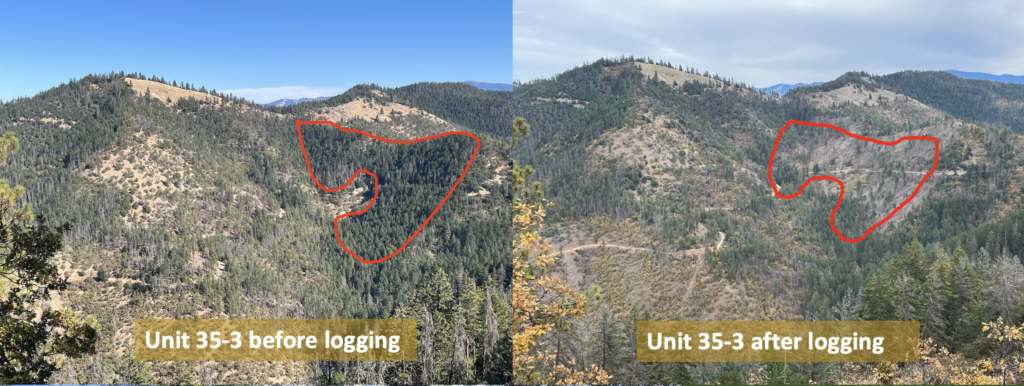
This photo series shows BLM’s selection of so-called “dead and dying” logging in the Boaz Salvage Timber Sale. Unit 35-5 was deemed “dead and dying” and at least 80% of the living trees were logged during BLM timber sale operations. What created more Doug-fir mortality? Drought or BLM Logging? This photo shows the truth — BLM logging is killing off the last of the living Doug-firs on the landscape.Unit 35-5 of the Boaz Salvage Timber Sale after logging took place. This once green, mature conifer forest was reduced to a few scattered trees and will soon regenerate into thick, highly flammable brush and young trees.
BLM Claims They Can Predict Which Trees Will Die by 2055! Ha!
Just like the recent SOS Project, the Douglas Fir Mortality Complex Project would log approximately 70% and 80% of all trees in each stand, including those with no signs of significant beetle infestation, a loss of vigor, or eminent tree mortality.
The BLM claims these trees are being removed based on predictions of future mortality — as many as 30 years in the future (2055) — when in reality they are being removed to increase timber volumes per acre and produce more profits for their timber industry “partners.” BLM cannot honestly say they can predict which trees will die by 2055 and no science supports these unfounded claims. Instead, they are being made to support increased timber production, ignore biological realities, and are contributing to widespread deforestation in our region.
Additionally, high value wildlife snags, and future downed wood are proposed for widespread removal in areas where more significant beetle mortality took place. This strips the regenerating forests of habitat complexity and natural regeneration. It also disturbs forest soils, making them far more susceptible to noxious or non-native weed spread, and far more susceptible to elevated levels of soil erosion and stream sedimentation.
During the past two years, BLM has more than doubled timber production implemented under its 2016 Resource Management Plan, while heavily utilizing this faulty narrative of “dead and dying” tree removal. They have done so with devastating consequences to the forests, watersheds, and local communities in the the Applegate Valley, and in both the Cascade and Siskiyou Mountains of southwest Oregon.
BLM Timber Sales Do Not Prevent Flat-headed Fir Borer Beetle Outbreaks
The BLM acknowledges that once “widespread FFB [flat-headed fir borer] infestation begins in a forested stand, there has not been a clear solution in stopping the damage.” Thus, BLM is not logging to reduce further beetle mortality, they are leveraging the hysteria around recent beetle mortality events in southwest Oregon to promote increasingly severe logging treatments across bigger and broader landscapes. (Flat-headed fir borer beetles are native insects!)
The Douglas Fir Mortality Complex timber sale proposes to log off both living and dead standing trees on the northwest face of Boaz Mountain and above the Upper Applegate Valley. If implemented, the timber sale would reduce this stand to a few scattered trees, and would eliminate virtually all closed forest habitats on the mountain.
The Douglas Fir Mortality Complex would include stands that are currently maintaining irreplaceable refugia habitat for species like the northern spotted owl, great gray owls, pacific fisher, Siskiyou Mountains salamanders, Klamath black salamanders, black bear, and ungulates like deer and elk. All these species require thermal cover, temperature moderation, decadence, complex habitat structures, and/or mature or late successional forest characteristics to support portions of their diverse life cycles, and these values would be heavily impacted by Douglas Fir Mortality Complex timber sales.
These same forests also support watersheds, springs, seasonal streams, and important stream flows contributing water to the Little Applegate and Upper Applegate River watersheds, and they would be heavily impacted by not only soil disturbance, erosion, and sedimentation from logging and yarding operations, but also through the 6.7 miles of new permanent road construction proposed by BLM in this project.
BLM Logging is Taking the Applegate Back to the Cut and Run Logging Era
If implemented the Douglas Fir Mortality Complex would change the face of the Little Applegate and Upper Applegate Valleys forever, converting mixed conifer forests into non-native annual grasslands or permanent shrubfields. The forests, the views, the wildlife, the watersheds, the scenic beauty, and the habitat functionality of the region is under heavy threat by BLM logging operations.
Additionally, the safety of our families and communities during wildfire events is threatened as BLM increases fire risks on public lands adjacent to our homes. Protecting these community values depends on home hardening, defensible space work, ingress/egress efforts, and a home outward approach to community wildfire protection, while logging in remote locations and on public lands far from private residences, municipalities, or rural communities has no direct benefit to the resilience of these homes or communities.
A recently clearcut slope on the northern face of Boaz Mountain. This unit was logged in the BLM’s Boaz Salvage Timber Sale, and before logging took place was considered a high priority site for the Siskiyou Mountains salamander. The stand supported mature, living forests with closed canopy habitat conditions. It is now a clearcut filled with noxious weeds.
The fact is that backcountry logging and manual fuel reduction in remote locations only draws resources away from more meaningful efforts to address community wildfire safety. In many cases, it also increases fire risks in the years following these logging operations as dense, woody vegetation fills in the canopy gaps and disturbed soils with even-aged young conifer regeneration, dense shrubs and stump sprouting hardwoods.
The Douglas Fir Mortality Complex, like the SOS Project before it, proposes to embed heavy industrial logging units directly adjacent to homes and communities making them less, not more secure during fire events.
The Douglas Fir Mortality Complex Project is not about supporting the resilience of local communities, it is about increasing the volume of timber offered to the timber industry from our public lands. It is about using the public’s fear of fire and misunderstanding of recent climate-induced, Doug-fir mortality events to log more forests, to implement increasingly more severe logging treatments, and to deliver unsustainable levels of timber to local mills .
The Medford District BLM is attempting to log every forest they can get their hands on under the Trump Administration’s pro-industry public land policies. Simply put, the Douglas Fir Mortality Complex proposal is Trump forestry in all its dishonesty, all its greed, all its arrogance, and all its indifference to the real, lasting environmental impacts.
From a biological perspective the project is incredibly misguided and would have lasting negative consequences. From a human perspective, the BLM is threatening the quality of life and the quality of habitat we enjoy here in southwestern Oregon. The Douglas Fir Mortality Complex Timber Sale would impact our communities, degrade our public lands and local watersheds, damage our recreation areas, and scar our hillsides with downright ugly logging scars.
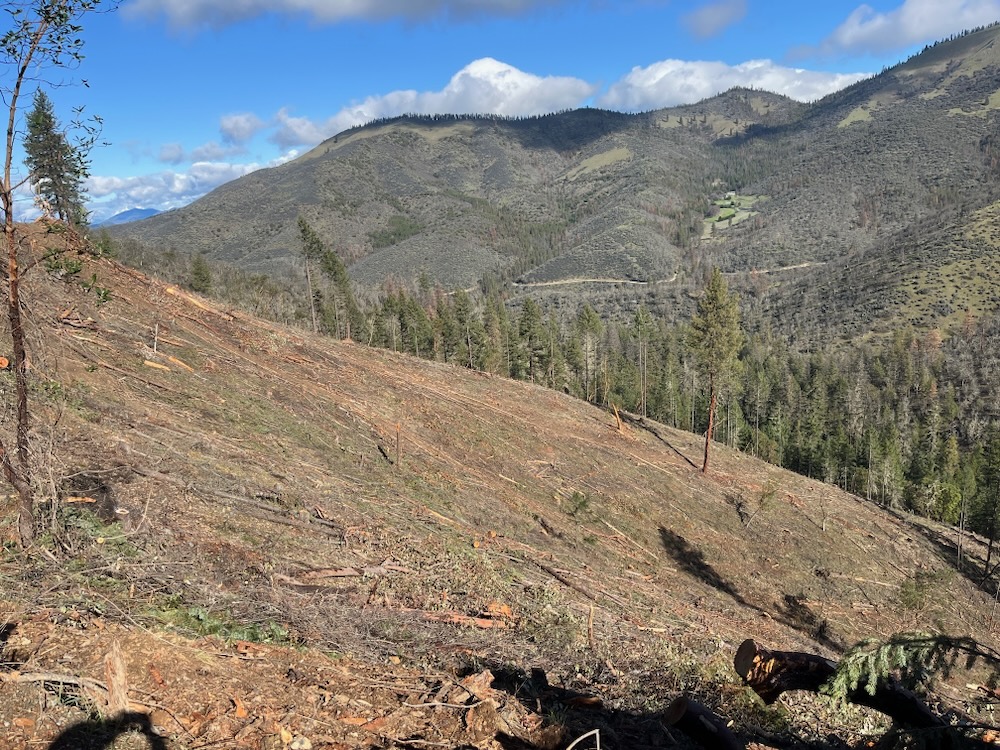
Slopes like these in the Little Applegate River watershed are proposed for logging and road construction in the Douglas Fir Mortality Complex timber sales. Currently a mixed conifer forest with mature forest habitat and patches of dead standing snags, if implemented the logging would leave only a handful of trees per acre, would temporarily denude this slope and create significant long-term fire risks by regenerating whole slopes of dense, even-aged growth. Natural habitat will look like an industrial logging zone.
This logging proposal is another excuse by the Medford District BLM to log off the public lands of southwest Oregon and the Applegate Valley. The agency has shown over many years to be solely fixated on the destruction of forest habitats in our region, and the production of private timber industry profit from everyone’s beautiful public lands.
During his confirmation hearings, Secretary of Interior Doug Burgham clarified that he views our public lands as a financial “asset” and referred to the resources on public lands as “America’s balance sheet.” Unfortunately, land managers at the Medford District BLM are obediently working to liquidate those assets, and they simply do not care who or what that might affect.
Recent BLM timber sales have led to landslides, debris flows, lawless, unregulated logging, type conversion to non-native annual grasslands and shrubfields, heavy stream sedimentation, dramatically increased fire risks directly adjacent to homes and communities, and real world impacts that BLM computer models and Environmental Assessments do not disclose or even consider.
A major landslide was triggered by BLM salvage logging in the Boaz Salvage Timber Sale. The slide has led to numerous debris flows that have filled in the seasonal stream below. During each rain event since this slide took place, thick sediment now flows into Neds Gulch and ultimately into the Applegate River where it impacts native fisheries and aquatic habitats.
The BLM is actively working to create timber sacrifice zones throughout the Applegate River watershed and we must actively oppose this destruction. Please join ASA as we fight the Douglas Fir Mortality Complex timber sales. Comments can be submitted until July 3, 2026 at the website below.
Maintain all live trees in “salvage” logging units. Do not log trees based on predicted or future mortality. BLM cannot predict which trees will die in 2055!
Do not log in forested refugia habitats that survived recent beetle mortality events and maintain either closed forest conditions, late successional characteristics, mature stand conditions, natural stand development, or open forest conditions surrounded by high quality, complex early seral habitat.
Build no new roads. No permanent or temporary roads.
The BLM must fully disclose the impact of recent salvage logging timber sales on hardwood habitats, on soils, on slope stability, on stream sedimentation, on sensitive and endangered species, on fire risks, and on future late successional forest development. None of these issues were adequately considered in the existing Environmental Assessment.
Maintain canopy cover and live trees in all stands. Focus any and all treatments on public safety by limiting felling operations to those that remove only true, dead standing, hazard trees threatening to fall into regularly used BLM roads, trailheads and other public infrastructure such as ingress/egress routes for local residents or the area’s recreational users.
Implement non-commercial fuel reduction where necessary to support safe ingress/egress on BLM lands (150′ from regularly used roads).
Do not implement “tethered assist” logging on steep, erosive slopes. Cabling on steep slopes has massive erosion impacts that impact native fisheries.
Do not authorize Riparian Reserve logging and do not yard through any Riparian Reserves within the project area.
Implement a 20″ upper diameter limit, to protect older, larger trees, to reflect the poor growing conditions, the lack of large diameter trees on the landscape, the significant age of relatively small diameter trees in the Applegate, and the need to maintain shade, microclimate and closed stand conditions where they have been persistent.
The East Applegate Ridge Trail is a beloved and threatened community asset
A view from the beloved East Applegate Ridge Trail towards Ruch and Ben Johnson Mountain. The Holcomb Hollow Timber Sale is imminently slated to log portions of this incredible and popular trail system, while Ben Johnson Mountain (in the distance above Ruch) has been devastated by BLM logging operations in the Apple Saws Timber Sale.
For many years residents in southwest Oregon have coalesced around a vision of long-distance, non-motorized trails extending across the Applegate River watershed and connecting communities throughout the Rogue River, Bear Creek and Applegate River Valleys of interior southwest Oregon. These residents have also built multiple organizations dedicated to building these trail systems with the ultimate goal being to link the proposed Applegate Ridge Trail and Jack-Ash Trail systems into the larger, approximately 80-mile Siskiyou Skyline Trail. The trail would extend from Grants Pass to Ashland, Oregon throughout the beautiful Applegate foothills and small portions have already been created.
Yet, since construction of the East Applegate Ridge Trail by the Applegate Trails Association (ATA) and the Jack-Ash Trail by the Siskiyou Upland Trails Association (SUTA) in 2017, residents in the area are just now realizing how vital, transformative, and popular this proposed trail system could be.
The East Applegate Ridge Trail now attracts thousands of visitors to trailheads in the Applegate Valley each year, and is just a ten-minute drive from Jacksonville at the edge of the Rogue Valley. The trail system is one of the most accessible, scenic, spectacular, and beloved trails in the region. This now iconic Oregon trail contains a beautiful mixture of oak woodland, thickets of chaparral, open grasslands, mixed hardwood forests, mature conifer forests, relatively undisturbed habitats, and colorful wildflower displays.
The area is also cherished for its incredible views across the Applegate Valley, the region’s rugged foothills, and the long, east-west tending spine of the Siskiyou Crest at the headwaters of the Applegate River. It is also popular with hikers, botanists, trail runners, and mountain bikers throughout the region and beyond.
The green forests in this photo are units 13-1 and 14-1 of the Holcomb Hollow Timber Sale and are proposed for heavy industrial logging. They are also within the viewshed of the East Applegate Ridge Trail where this photo was taken. According to the BLM’s Environmental Assessment, the prescriptions in this timber sale call for the removal of nearly all the living trees in these stands, leaving as little as 5% canopy cover, decimating the islands of conifer forests that are surrounded by beautiful oak woodlands.
The East Applegate Ridge Trail provides our region with a sense of pride in both the beauty of this place, and in the local community that has worked so hard to envision, promote, gain BLM approval, build, and maintain this incredible non-motorized trail.
Unfortunately, both the trail’s scenic beauty and the massive community effort that led to the trail’s creation are threatened with BLM logging under the Holcomb Hollow Timber Sale, and this logging could begin any day.
The Holcomb Hollow Timber Sale is damaging to the environment
The results of the Holcomb Hollow Timber Sale on the western face of Woodrat Mountain. Many of the units closely resemble clearcuts and every merchantable tree was removed, including living, green conifer trees, living, green hardwood trees, and dead standing snags.
The Holcomb Hollow Timber Sale is a 679-acre timber sale authorized by the BLM under their disastrous Ashland 2025 SOS logging project. Thus far, the Holcomb Hollow Timber Sale has logged the western face of Woodrat Mountain doing great damage to the area’s forests and woodlands. This sale also includes logging units, which have not yet been implemented, on BLM lands in the Sterling Creek area, and in multiple locations along the East Applegate Ridge Trail.
The East Applegate Ridge Trail would be heavily impacted by BLM logging
Although the BLM claims to be logging only “dead and dying” trees in the SOS project and Holcomb Hollow Timber Sale, numerous units proposed for logging contain living, green stands with mature forest canopy. A deeper dive into the timber sale’s tree removal mark also shows that many large, living, fire resilient trees that survived recent beetle mortality outbreaks are now being proposed for removal. In fact, the BLM’s own analysis shows that some stands being proposed for logging sustained as little as 10% mortality. Yet, the Holcomb Hollow Timber Sale Prospectus reveals that 73% of the trees in these stands would be removed.
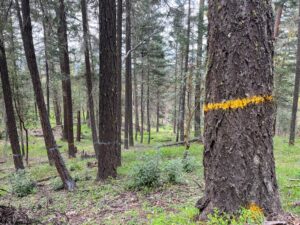
Only trees marked yellow will be retained in unit 13-2 along the East Applegate Ridge Trail, leaving virtually no canopy cover, no shade, and no forest to speak of. The prescription will log many large diameter, living Douglas fir trees, as well as habitat rich snags. In this photograph, only three trees would be retained and the forest floor will be churned by heavy equipment leaving a few scattered trees, heavily disturbed soils and non-native or noxious weeds, where beautiful wildflowers once dominated.
Although the agency claims to be using a scalpel to selectively harvest only the most unhealthy trees, and those most likely to die, the actual outcome and on-the-ground results of the Holcomb Hollow Timber Sale has included the removal of mature, living forest canopy, large fire resistant trees, habitat rich snags, and virtually everything in between.
For example, the SOS Project claimed to “promote hardwoods,” and the Holcomb Hollow Timber Sale Prospectus “reserved” them from timber harvest; however, hardwoods have been systematically removed across hundreds of acres in both the Holcomb Hollow and nearby Apple Saws Timber Sales, leaving a few scattered, often badly damaged trees per acre in some locations, and virtually none in others.
A large diameter madrone logged in the Holcomb Hollow Timber Sale and decked for removal along the Woodrat Mountain access road.
Logging off these hardwoods, and the living, resilient conifers that survived the recent beetle mortality events in the Applegate River watershed has significant unanalyzed impacts, and creates fundamentally different outcomes than those disclosed in the BLM’s Environmental Assessment or authorized in its Decision Record.
The logging proposed along the East Applegate Ridge Trail would heavily degrade the recreational experience by logging off some of the only forested habitats traversed by the trail, and many of the forests in the trail’s immediate viewshed. The project would log stands to as low as 5-20% canopy cover, leaving a few scattered trees where living, green forests once stood. It would also eliminate the only real shade along the trail, and along this otherwise sunbaked ridgeline.
The area also supports populations of the great grey owl, which nests in conifer stands within the area. Significant effort was made during the creation of the East Applegate Ridge Trail to avoid impacts to these great grey owl habitats. Now these same mature conifer forests are being proposed for heavy industrial logging with potentially long-term impacts to this important nesting habitat.
Additionally, the controversial Bear Grub Timber Sale was proposed a number of years ago by the BLM, in the same immediate location. Yet the Bear Grub Timber Sale was canceled, in part, due to impacts to the rare Pacific fisher, and its old forest habitat. Now BLM has proposed to log these same stands, but with much more intensity, creating more damaging impacts to Pacific fisher denning habitats .
The timber sale also includes both cable yarding units in the viewshed of the trail, where currently green forests will be heavily logged and streaked with vertical cable yarding scars. This form of yarding tears up forest soils as the trees are repeatedly dragged uphill on steep mountain slopes and in long vertical corridors. Often the BLM requires one end log suspension, which allows the other end to scrape and drag across the forest floor. This creates long, vertical strips of heavily disturbed soil, significant soil compaction, soil displacement, and erosion that can create small gullies that channelize water and have been documented to contribute to debris flows and slope failures.
The units directly adjacent to the trail would be subjected to ground-based yarding where large tractors drag logs across forest soils, destroying the spectacular native wildflowers the trail is known for, gauging deep into forests soils, creating widespread soil compaction, extensive soil disturbance and often a conversion from native understory species to highly flammable non-native annual grasses and noxious weeds. Disturbance from equipment use and the degradation of native plant habitat is a significant impact along the East Applegate Ridge Trail, which is loved for its abundant native wildflower displays and high quality pollinator habitats.
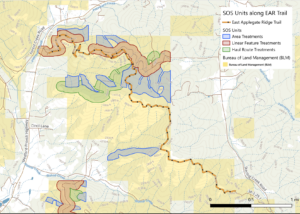
A map of logging units along the East Applegate Ridge Trail. All blue “area units” and red “linear feature” units are commercial “salvage” logging units with significant live tree logging, canopy reduction, large tree removal and snag removal.
The scars of Holcomb Hollow Timber Sale will also damage the scenic viewsheds and the quality of both the environment and recreational experience directly adjacent to the trail. Especially, for the first two and a half miles, east from Highway 238, significant damage will be done.
Not only will the first half mile of the trail be converted from a trail on an old, gated, overgrown roadbed to a full blown timber haul road, but landings would also be created, large soil sterilizing machine slash piles would be built and later burned, and the surrounding forests heavily logged. The first two miles of now scenic mountain canyon would be riddled with logging units devouring each major stand of conifer forest, including those with both minimal and relatively significant recent tree mortality.
Additionally, approximately 1/4 mile of trail would run directly through unit 13-2, which would log off the trail and the surrounding ridgeline. Meanwhile the BLM would log straight to the trail in unit 11-1, 13-4 and 13-5.
Please contact BLM and let them know you love the East Applegate Ridge Trail and do not want to see it logged!
You can sign onto a quick letter and send it to elected officials and BLM land managers here.
Please add into the letter that you want to see the logging along the East Applegate Ridge Trail CANCELLED!
Better yet, send the BLM a personalized message extolling your love for the unlogged East Applegate Ridge Trail and your desire to see the Holcomb Hollow Timber Sale canceled.
Medford District BLM Field Manager, Elizabeth Burghard:
Which do you prefer on your favorite local hiking trail?
Relatively natural forests and intact plant communities?
Only one tree along this section of trail would be retained in unit 13-2 of the Holcomb Hollow Timber Sale. The BLM and the timber sale purchaser, Parker Excavation and Forestry, would log right to the trail in stands that already contain very little tree density and minimal fire risks. The unit would also be tractor logged using ground-based equipment. This will tear up the forest floor and impact the native plant communities and wildflower displays this area is so well known for.
Or… heavily logged and disturbed landscapes impacted by BLM timber sale operations?
This Riparian Reserve on the western face of Woodrat Mountain was clearcut by Parker Excavation and Forestry in unit LF-26.1 of the Holcomb Hollow Timber Sale. The timber sale removed both dead standing snags and many large diameter, living Douglas fir trees, including those over the 36″ diameter limit.
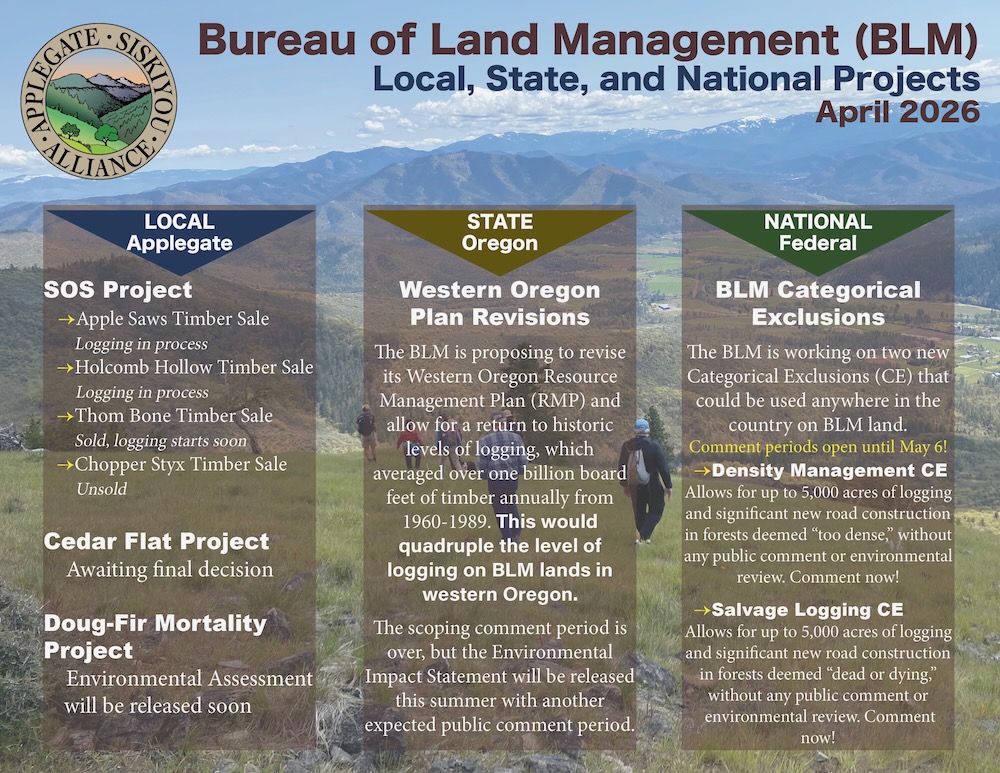
On a national level the BLM has proposed two new Categorical Exclusions (CEs) that collectively, would rubber-stamp commercial logging in forests and woodlands across the country.
BLM calls the logging of large, old, fire resistant trees “fuel reduction,” and commercial “thinning” often includes the removal of nearly all mature trees in a stand. This stand in the Nedsbar Timber Sale was proposed for heavy industrial logging with trees painted white identified for removal. The timber sale was never logged due in part to public opposition, and could be threatened again if BLM has its way.
Utilizing a CE for project approval triggers a process that categorically excludes the public from the public land management planning process and takes away existing opportunities for public comment. The process also eliminates requirements for a substantive environmental analysis, and the disclosure of environmental effects.
COMMENT NOW! Links to comment on these projects are at the bottom of this blog post. Comments are due May 6th, 2026.
Simply put, a CE allows the BLM to approve land management projects that the agency claims will have minimal environmental effects, but it is not required to back up those claims with analysis. It also allows the agency to do so while excluding you, community groups, environmental advocates, and virtually everyone but the timber industry from the process. On a practical level, what these two CEs would do is allow the BLM to authorize virtually any large-scale logging project it can design, logging its way across the landscape 5,000 acres, or 7.8 square miles at a time.
Historically, public involvement included the release of a scoping notice during the early stages of project planning, and a scoping comment period. In theory, this allows the public some ability to influence projects as they are designed, developed, and analyzed. This process is then followed by the release of an Environmental Assessment (EA) or Environmental Impact Statement (EIS), and another public comment period. This is intended to allow the agency to to gauge public opinion, consider public input, and both design and approve projects that were influenced by the public involvement process. Historically, this also included public meetings, or field trips to discuss the proposed project during these official comment periods.
The BLM’s Lickety Split Timber Sale was approved with a Categorical Exclusion because the agency determined the project would not have a significant impact on the environment; however, the project resulted in large clearcuts, like this one pictured above, and it heavily logged hundreds of acres in the Little Applegate River watershed.
Under a CE, this public involvement and environmental analysis process would be abandoned, and the BLM would simply design, develop and authorize a logging project internally, without any public involvement or notification. The first notification to the public would be the announcement of a Decision Record and timber sale auction, which are now also closed to the public.
In this process, the BLM would no longer conduct or allow for public comment; they would no longer analyze the potential impact of project activities, and they would no longer disclose to the public what the impact of these management activities might be. Instead, the process is designed specifically by the BLM to rubber-stamp damaging BLM timber sale activities and fast-track large-scale logging projects on forested BLM lands throughout the country, including western Oregon and the Applegate River watershed.
The Apple Saws Timber Sale currently being implemented above Ruch, Oregon has devastated the forest canopy and damaged wildlife habitat on the face on Ben Johnson Mountain. The BLM claims projects like this have so little impact that they can be authorized without public comment, scientific review, or the public disclosure of environmental impacts.
Although proposed separately, in practice these CEs would allow BLM to authorize the type of lawless, widespread, industrial-scale logging the Trump Administration envisions on our public lands with virtually no public accountability. It would allow for heavy logging, at a landscape scale in both living green forests and in forests subjected to natural disturbance processes like wildfire, beetle outbreaks and other forms of tree mortality.
Make no mistake, this is a blank check to log virtually any forest the BLM chooses, while excluding credible science, substantive environmental review and public involvement.
If authorized, these CEs would allow BLM to log virtually every public forest in its ownership by approving unlimited numbers of 5,000-acre timber sales, and if previous attitudes at BLM are any indication of the future, the agency will immediately unleash a flurry of CEs and timber sales once this is approved. The agency will most certainly log off the forests you love, and the forests that are so important in maintaining habitat both throughout the region, and across this beautiful country.
The new Categorical Exclusion for density management and green tree logging projects on BLM lands
Historically, the agency has allowed for the Categorical Exclusion of commercial logging to address “forest health” concerns in living, green stands; however, it has been limited in each individual CE to 70 acres and 0.5 miles of new road construction. We have seen this Categorical Exclusion misused to authorize damaging logging and road construction projects with significant environmental effects, however, we have thankfully also seen most green, or living tree timber sales implemented using full public comment periods and environmental review to analyze and disclose the impact of the logging proposed in an Environmental Assessment (EA) or Environmental Impact Statement (EIS).
This new CE proposes “commercial thinning,” but provides virtually no limitations on where these treatments would take place, no diameter limit on tree removal, no canopy cover retention targets, and although it specifically excludes clearcut or regeneration harvest, it would allow group selection logging clearcuts up to 2 acres in size, and heavy industrial-scale logging that retains minimal canopy cover and a few scattered trees per acre.
Group selection logging is a form of staggered clearcut logging that removes whole groves of mature trees. This group selection “opening” was created during the Sterling Sweeper Timber Sale in the Little Applegate Valley and has since filled in with dense, highly flammable young growth.
It would also authorize projects with as much as 5 miles of new permanent road construction and up to 2.5 miles of new “temporary” road per 1,ooo acres of treatment area. This means as much as 12.5 miles of “temporary” road per 5,000-acre project area.
What the BLM has proposed in this new Categorical Exclusion is the implementation of “density management” logging at a much larger scale and with very few guardrails, authorizing Categorical Exclusion for projects up to 5,000 acres, or approximately 7.8 square miles in size. This is more than 70 times the size of the current Categorical Exclusion authorizations for “forest health” or “density management” type logging operations, and would have significant impacts on public resources, biological values, recreational settings, and scenic values for communities and watersheds across the region.
Conditions following commercial thinning in the O’Lickety Timber Sale in the Little Applegate Valley. Following the heavy thinning operations windthrow was significant and further reduced canopy cover and impacted northern spotted owl habitats.
The impact of a single CE would be devastating on a local scale, and the implementation of unlimited numbers of CEs across virtually all BLM forest or woodland nationwide is simply enormous. The CE is essentially a public forest give-away to private industry and must be vigorously opposed.
The new Categorical Exclusion for “salvage” logging on BLM lands
Current Categorical Exclusion authorizations for salvage logging are limited to 250 acres and up to 0.5 miles of new temporary road construction. Again, we have seen this Categorical Exclusion for salvage logging repeatedly misused to target living, green trees, and to implement projects with very significant environmental effects. Large-scale salvage logging, over 25 acres, as proposed by the BLM in this new CE, has historically been implemented using full public comment and environmental review with and Environmental Assessment (EA) or Environmental Impacts Statement (EIS).
ASA has monitored numerous recent projects authorized under the current 250-acre “salvage” logging CE, and these projects have targeted predominantly living trees, and created immense amounts of damage to local habitats, watersheds, wildlife, wildfire resilience, and scenic values in the Applegate Valley. This includes the devastating examples of the Boaz Salvage Timber Sale, the Forest Creek Salvage Timber Sale and the Lickety Split Timber Sale, where industrial logging in living green forests, illegal road construction, unauthorized yarding activities, unenforced Project Design Features, wet weather logging, and poor or non-existent project administration led to landslides, debris flows, permanent damage to streams, the bulldozing and clearcutting of Riparian Reserves, and unanalyzed levels of damage to living forests, native vegetation and habitat values.
The BLM claims units like this one in the Forest Creek Salvage Timber are not clearcuts, but the results on the ground show otherwise. The BLM implemented this project on an assumption of “no significant environmental impacts,” again the results on the ground show otherwise.
The newly proposed CE is intended to scale up these impacts by allowing large-scale salvage logging in areas up to 5,000 acres, or across 7.8 square miles in size. It would also allow the construction of up to 1 mile of new permanent road construction and up to 2.5 miles of so-called “temporary” road per 1,000 acres of treatment area. This would authorize up to 20 times the acreage in the current CE and would dramatically increase impacts associated with widespread road construction.
Like the new density management CE, this new “salvage” logging CE provides virtually no limitation on where these treatments might take place, meaning they will be used across the entire BLM landscape.
We know firsthand in the Applegate how this narrative of “dead and dying” trees, and “salvage” logging can be used by the BLM to target living, viable stands of mature forest, devastating local watersheds, wildlife habitat, and scenic values. We also know the damage associated with salvage logging in stands with significant mortality and the lasting impact this logging has on habitat values, forest regeneration and future fire risks.
Now imagine, the landslides, clearcuts, the widespread green tree logging, and environmental damage of last winter’s Boaz Salvage Timber Sale implemented across 20 times more land. Imagine projects like the current SOS logging project, which is decimating the habitats around Ruch being approved one after another, with no opportunities for our communities to have a voice in the process. This is the vision of the Trump Administration and their willing partners at BLM, who are eager to cut the public out of the process, while they cut down our public forests.
A landslide triggered by salvage logging on BLM land in the Boaz Salvage Timber Sale. Implemented with a CE, the BLM claimed this project would have such minimal impact that public comment and scientific review were unnecessary. This 250-acre salvage timber sale was the most damaging timber sale implemented in recent decades on BLM lands in the Applegate Valley and was responsible for landslides, debris flows, the bulldozing of whole seasonal stream channels, the conversion of riparian areas into skid trails, the clearcutting of living, green forests, and the retention of only 3.4 trees per acre.
Combined these two Categorical Exclusions, along with the proposed RMP Revisions would irreparably damage our public lands, degrade wildlife habitats, impact fisheries and degrade the beautiful public lands we enjoy today. It would also degrade trust in the BLM, and leads to a very valid questioning of the agency’s commitment to public values, public involvement, and a livable planet for future generations.
Please comment now on these irresponsible Categorical Exclusion proposals—if implemented they will change BLM forests and woodlands forever.
COMMENT NOW! Talking Points for the Density Management CE
Commercial logging projects proposed at the scale envisioned under this new CE would create significant environmental impacts on local watersheds, wildlife, fire resilience, habitat connectivity, biodiversity, and on local human communities.
Current BLM logging practices are creating significant environmental effects and demonstrate a need to implement full comment periods and environmental analysis/review for all projects of the scope, scale and intensity proposed. This requires the release of an Environmental Analysis or Environmental Impact Statement with site specific, project level analysis for each individual logging project.
Commercial logging can increase fire risks by logging large fire resistant trees, reducing canopy cover, increasing understory fuel development and creating hotter, drier, more fire prone environments.
Commercial logging and road construction at the scale and intensity proposed will damage watersheds and fisheries by increasing sedimentation and reducing water quality.
Commercial logging, density management, and road construction at the scale proposed will have negative impacts on endangered species, wildlife habitat, mature, late successional, and old growth forests, scenic values, recreational values and local economies.
Proposals to increase the scope, scale and use of Categorical Exclusions are undemocratic, unlawful, inappropriate, and fail to maintain the public interest in public land management planning.
For more information on this new Density Management CE proposal and to provide public comment, click on the buttons below.
COMMENT NOW! Talking Points for the Salvage Logging CE
Salvage logging has significant biological impacts and no credible biological benefit to forest or woodland ecosystems.
BLM salvage logging often includes significant green, or living tree removal and is typically implemented as clearcut logging which increases fire risks, degrades habitat values, damages watersheds, and impact the areas scenic qualities.
Salvage logging projects proposed at the scale envisioned under this new CE would create significant environmental impacts to local watersheds, wildlife, fire resilience, habitat connectivity, biodiversity, and on local human communities.
Current BLM salvage logging practices are creating significant environmental effects and demonstrate a need to implement full comment periods and environmental analysis/review for all projects of the scope, scale and intensity proposed. This includes at least an Environmental Assessment or Environmental Impact Statement for each individual timber sale project.
Salvage logging can increase fire risks by logging large fire resistant trees, reducing canopy cover, increasing understory fuel development and creating hotter, drier, more fire prone environments.
Salvage logging and road construction at the scale and intensity proposed will damage watersheds and fisheries by increasing sedimentation and reducing water quality.
Salvage logging and road construction at the scale proposed will have negative impacts on endangered species, wildlife habitat, mature, late successional, and old growth forests, scenic values, recreational values and local economies.
Proposals to increase the scope, scale and use of Categorical Exclusions are undemocratic, unlawful, inappropriate, and fail to maintain the public interest in public land management planning.
For more information on this new Salvage Logging CE proposal and to provide public comment:
The Trump Administration’s Bureau of Land Management (BLM) has set their sights on Western Oregon forests and has started the process to revise the BLM’s 2016 Resource Management Plan (RMP). The goal is to dramatically increase timber production on 2.4 million acres of BLM lands, “to provide a sustained yield of timber production consistent with the maximum productive capacity of the lands.”
The BLM intends to quadruple timber production in Western Oregon from the already too high 250 million board feet per year, to approximately 1 billion board feet annually.
Landslides and debris flows triggered by clearcut logging on Medford District BLM lands in the Boaz Salvage Timber Sale. The BLM is proposing to ramp up this type of logging throughout Western Oregon under the Trump Administration’s RMP Revision.
Like so many of the administration’s regressive policies, these RMP Revisions propose to take us back to the wildly unsustainable timber harvest levels of 1960-1990 when whole watersheds of old-growth forest were being liquidated in vast clearcuts, roads were being punched into remote habitats, wildlife populations were plummeting, watersheds across the state were failing and fisheries were collapsing in unison across the Pacific Northwest.
Old-growth forests like these on the northern face of Grayback Mountain could be logged under the BLM RMP Revision.
In practice, what the current RMP Revision will do is strip the region of environmental, watershed, and habitat protections and facilitate widespread clearcut logging and new road construction on the vast majority of the agency’s land in Western Oregon. This would impact beautiful BLM lands and important habitats between the Columbia River and the California border in the Coast Ranges, on the western slope of the Cascade Mountains, and in the Siskiyou Mountain of southwest Oregon, including the Applegate River watershed and broader Siskiyou Crest region.
Old forest previously proposed in the Late Mungers Timber Sale were spared by recent IVM litigation, but would be threatened all over again by the logging proposed in the RMP Revision.
This level of harvest can only be described as deforestation and wholesale environmental destruction. A return to this level of industrial timber harvest will lead to a dramatic expansion in clearcut logging, the development of highly flammable plantation stands across broad landscapes, high-graded and heavily logged stands with virtually no biological integrity, enormously detrimental watershed effects, and scenic Oregon viewsheds riddled in unsightly logging scars and new road cuts.
Ironically, these issues have been resolved in the courts and both BLM and big timber’s interpretation of the 1937 O&C Act, as a timber-only mandate has been thoroughly rebuked. Unable to accept these limitations on their plunder of public lands the BLM, the timber industry, the O&C Counties (such as Jackson, Josephine, and Curry County is southwestern Oregon), and the Trump Administration are intent on increasing timber production, regardless of the enormous impacts.
Representing the politics of corruption, greed, and unsustainable excess, the BLM has been fully captured by the timber industry and is prioritizing short-term profits for wealthy shareholders, over the health of our forests, watersheds, and communities in Western Oregon.
Rivers and streams would be heavily impacted by increased logging proposed by the BLM in the RMP Revision, including this portion of the Little Applegate River on Medford District BLM lands.
Many of the rural communities in the region have transitioned from unsustainable timber-dependent economies to more balanced economies centered around tourism, outdoor recreation, fisheries, agricultural enterprises and amenities. In this way, the beauty of the region is central to its economic vitality, and the shift away from heavy, industrial scale resource extraction also supports a higher quality of life for local residents, maintains a beautiful, healthy environment for the benefit of surrounding communities, and provides cold, clean water to regional farms, ranches, vineyards, and river ecosystems.
Western Oregon is known for its beautiful coastlines, towering forests, verdant streams, wild rivers, world-renowned fisheries, intact mountain vistas, and abundant wildlife. Many in the region take pride in where they live, the natural beauty it offers, and its incredible biodiversity. We feel blessed to live in such spectacularly scenic landscapes and value them immensely.
Beloved places like the Burton-Ninemile Lands with Wilderness Characteristics in the Applegate Valley and all conservation-based Land Use Allocations would be threatened under the Western Oregon RMP Revision.
The BLM’s RMP Revision is a threat to what we love in Oregon and must be stopped. We implore our neighbors, residents throughout the state, visitors who love the region, conservationists, hikers, hunters, fishers, whitewater rafters, botanists, birders, elected officials, and all who love Oregon’s public lands to speak out for its defense.
Please comment on the Scoping Notice for the RMP Revision and tell BLM:
The proposed increase in logging is unsustainable, irresponsible, and will degrade public resources like clean water, fisheries, intact forests, wildlife habitats, and public wildlands.
Timber production in the Annual Sale Quantity (ASQ) should be adjusted downward to compensate for the 2021 Labor Day Fires, recent beetle outbreaks in southwest Oregon, and mortality related to climate and drought effects.
Oregon’s public lands should be managed for public values, not private timber industry interests.
The courts have confirmed that O&C Lands should be managed for multiple uses, including conservation, wildlife, watersheds, recreation, and others. These lands do not have a timber-only mandate.
Maintain and expand all current conservation-based Land Use Allocations, including Areas of Critical Environmental Concern, Lands with Wilderness Characteristics, Wild and Scenic Rivers, Wilderness Areas, Late Successional Reserves, Research Natural Areas, and Riparian Reserves.
Heavy commercial logging, as proposed by the BLM in the RMP Revision, will dramatically increase fire risks by removing large fire resistant trees, altering microclimate conditions, and regenerating dense, highly flammable young growth. This creates conditions that are conducive to hotter, more fast-moving fires.
Many rural communities have transitioned away from public land timber production and into more sustainable, balanced economies. These economic activities will be significantly harmed by increased timber production.
The BLM has proven themselves so irresponsible in their management of public lands and has so thoroughly violated the public’s trust, that I support the transfer of all BLM lands in western Oregon to the adjacent National Forests.
Note: Our own Medford District BLM Manager Elizabeth Burghard, is the official Oregon/Washington BLM contact for this RMP Revision and Western Oregon clearcut logging plan. After increasing timber production here on the Medford District in the past two years, apparently the Oregon/Washington Office and the Trump Administration took note, putting her in charge of the largest BLM Timber Grab in recent history! She is the official contact for this project and all communications should be addressed to Elizabeth Burghard, the individual most responsible for the current logging impacts in the Applegate, and the point person for the destruction of forests across the state!
Take Action!
Provide comments to the BLM through the following methods:
Sending in your own letter is the most powerful way to have your voice heard, but you can also send a quick letter through the Center for Biological Diversity‘s letter campaign here:
Click play to watch a short video from on-the-ground monitoring of the Apple Saws Timber Sale on Ben Johnson Mountain above Ruch.
Ben Johnson Mountain and the famous valley views of Ruch, Oregon with the units identified in red. This photograph was taken before implementation of the Apple Saws Timber Sale.
Ben Johnson Mountain rises like a broad, forested dome directly above the popular Cantrall-Buckley County Park and its swimming holes along the Applegate River. The mountain is visible from residences, vineyards and farms across the Ruch area, and from nearby hiking trails like the East Applegate Ridge Trail.
On New Year’s day, the Medford District BLM and Estremado Logging began logging off the mountain’s eastern face, desecrating our beloved mountain with logging scars. Although the BLM claims to be logging only dead and dying trees in this timber sale, the forests on these slopes contain very little recent tree mortality. In fact, these forests survived the 2022-2023 flat headed fir borer outbreak as refugia habitats, and relatively little tree mortality has occurred.
Ironically, the BLM admits that some stands in the Apple Saws Timber Sale may contain as little as 10% mortality, and some appear to have far less when surveyed on the ground, and yet, astoundingly the BLM proposes to log 82% of the trees in these forests, leaving little but scattered trees, vertical skyline yarding scars, and soils churned, compacted, and displaced by heavy equipment use.
Whole stands of living, green forest is being logged off in the Apple Saws Timber Sale above Cantrall-Buckley County Park.
Additionally, the BLM is allowing the logging contractors to exceed authorizations in the applicable BLM documents. What we have found in the Apple Saws Timber Sale is the myth presented by the BLM in their timber sale approval documents, and the realities, which are demonstrated clearly on the ground.
Much like the recently implemented Boaz Salvage Timber Sale, which ended in landslides, debris flows and permanent damage to forests, riparian areas and streams, the Apple Saws Timber Sale is being implemented with disregard for public resources and the agency’s own regulations, and it is having tragic consequences.
The BLM has woven a narrative about reducing fire risks, mitigating environmental effects, and implementing Project Design Features (PDFs) to protect public resources, but these are myths, not supported by the evidence on the ground. The Apple Saws Timber Sale is a disaster in the making, and like the Boaz Salvage Timber Sale implemented last winter, it is being implemented in a manner that dramatically exceeds the environmental impacts analyzed or authorized in the Ashland 2025 SOS Environmental Analysis (EA), the Ashland 2025 SOS Decision Record #3 for the Apple Saws Timber Sale, or Apple Saws Full Timber Sale Prospectus.
Apple Saws Timber Sale: The Myth and the Reality
A large opening logged off in the Apple Saws Timber Sale. Every stump in this photograph was a live tree, with green vibrant foliage contributing to the overstory canopy in the stand.
Only the first few units have been implemented in the Apple Saws Timber Sale, but already both the myths of the BLM’s analysis and impacts of the project are becoming crystal clear. Currently, the agency is not just looking the other way while authorizations are violated, they are knowingly allowing, and excusing the lack of compliance on the ground, leading to impacts that exceed those authorized by the BLM.
Myth #1 – Only dead and dying trees are being cut and removed
“Retain all healthy trees which show no signs of insect infestation or decline unless removal is required for safety or operational purposes.” (Ashland SOS EA P. 11)
“Within stands experiencing mortality, healthy living trees are not the target of salvage harvest.” (Ashland SOS Decision Record #3 P.8)
“Area units are RETENTION MARKED in WHITE for salvage harvest. All unmarked Douglas-fir trees meeting minimum merchantability specifications have been deemed dead or dying.” (Apple Saws Full Timber Sale Prospectus P. 2)
“Reserve all healthy, green trees in all DXP-LF units” (Timber Sale Prospectus P. 5)
Reality #1 – Significant living, green trees are being felled and removed across the Apple Saws Timber Sale
Whole stands of living, green mature forest is being felled and removed in unit 32-7 and across the Apple Saws Timber Sale. These are not dead and dying trees, but instead were some of the most resilient living forests remaining adjacent to the valley floor near Ruch. Where logging has occurred most of the forested stands are now reduced to only a few scattered trees.
Whole stands of living, green, non-beetle infested trees are being logged all across the Apple Saws Timber Sale. In fact, the Ashland 2025 SOS EA allows for logging in stands with as little as 10% mortality, and the timber sale prospectus reveals that 82% of the trees in these stands will be logged, in the timber sale if fully implemented.
Currently, the first few units have been logged and have included predominantly the removal of living, green trees, as well as extensive trees marked white for “retention,” but logged by Estremado Logging throughout the timber sale.
In response to our complaints that many living, green trees and retention trees are being removed, BLM has responded by stating, “The Apple Saws Timber Sale is removing dead and dying Douglas-fir trees as analyzed in the Ashland 2025 SOS Environmental Assessment and authorized in Decision Record 3.” They also claim, “Conifer trees that were reserved marked and cut for operational purposes (yarding corridors) have been swapped with conifer trees that were not reserve marked to maintain adequate post-harvest residual densities.”
A portion of unit 32-7 of the Apple Saws Timber Sale after tree felling, but before yarding operations occurred. As is clearly visible, almost every tree cut and on the ground contains living, green foliage and no sign of beetle infestation.
What we can see on-the-ground in the Apple Saws Timber Sale is the widespread removal of living, green, non-beetle infested trees. In fact, almost none of the trees we have seen felled throughout this timber sale were dead standing snags. Additionally, large Douglas fir trees clearly marked for “retention” have been cut at scale across unit 32-7, and it does not appear they were replaced with comparable trees or “swapped” out as the BLM suggests.
We are also concerned that canopy cover and density targets are not being met and northern spotted owl habitat development is being “precluded and delayed” for more than 20 years in violation of the BLM’s 2016 Resource Management Pland and its management direction for Late Successional Reserve (LSR) forests. The flanks of Ben Johnson Mountain and the surrounding areas are LSR forest and should be managed for the maintenance, enhancement, and recruitment of late successional forests. This timber sale is having the opposite affect and will set back LSR habitat values for many decades to come.
Myth #2 – Hardwoods are not being cut and removed across the Apple Saws Timber Sale
Despite the BLM’s claims that large madrone and black oak would be “reserved” during logging operations, they are being felled and removed across the Apple Saws Timber Sale. Approximately 80% of the hardwood population has been removed in affected units. The removal currently occurring dramatically exceeds the affects analyzed and authorized in BLM NEPA documents, and dramatically exceeds what is necessary for operational safety. .
“Retain all hardwood species unless removal is required for safety or operational purposes.” (Ashland SOS EA P. 11)
“The Ashland SOS project proposes to retain healthy living trees, leave snags in proposed units, and promote hardwood species.” (Ashland SOS Decision Record #3 P. 25)
“Hardwood regeneration is important for providing species diversity, varied age classes, and structural layering. Hardwoods will be retained except where operationally infeasible.” (Ashland SOS Decision Record #3 P. 34)
“Reserve all cedar, pine, hardwoods, and Pacific yew in all units as shown on Exhibit A, except where falling is necessary for safety or operational reasons. If such trees need to be cut for safety or operational reasons, retain cut trees in the stand.” (Apple Saws Full Timber Sale Prospectus P. 1 of 29)
Reality #2 – Significant hardwood populations are being felled and removed across the Apple Saws Timber Sale
Madrone logs are being felled, sorted, decked and sold by Estremado Logging, despite being reserved from logging. The BLM documents clearly state that the logging company bought only Douglas fir logs and was to remove only Douglas fir logs, yet vast quantities of madrone are being removed and turned into commercial products.
Hardwoods, including at least 80% of the madrone and black oak on site are being felled and removed across the Apple Saws Timber Sale. This includes large mature madrone trees by the thousands, many of which are being felled, yarded to the road, sorted, decked, and hauled off in log trucks despite not being authorized for felling or removal.
The wholesale removal of hardwood trees for firewood was explicitly not allowed under the timber sale contract or BLM NEPA documents. Yet, the systematic removal of hardwoods is occurring throughout the timber sale area.
The felling, yarding and removal of hardwoods for firewood is occurring openly throughout this timber sale, despite the fact that Estremado Logging did not buy the hardwoods and is not authorized to fell, yard or remove them from the site at this scale.
The Apple Saws Timber Sale is completely decimating, rather than “promoting” and “retaining” the hardwood component as the EA, Decision Record, and Timber Sale Prospectus suggest. Additionally, the retention and promotion of hardwoods was required to meet canopy cover, basal area, and Northern spotted owl habitat targets identified by BLM during the planning process.
The removal of hardwoods at scale renders the EA analysis invalid and demonstrates that BLM logging operations dramatically exceed the impacts analyzed, authorized, and disclosed to the public in the applicable BLM documents. The retention and promotion of hardwoods in the Apple Saws Timber Sale is a myth untethered from reality.
Myth#3 – No wet weather logging will occur
“No road construction, landing construction, skid trail construction, road renovation, road reconstruction, road decommissioning, road blocking/barricade construction, rocking, water bar construction, soil ripping, shall be conducted within contract area between October 15th of one calendar year and May 15th of the following calendar year, both days inclusive, or when soil moisture exceeds 25%, as determined by the Authorized Officer.
No ground-based yarding or soil decompaction operations shall be conducted within contract area between October 15th to May 15th, or when soil moisture exceeds 25%.” (Apple Saws Full Timber Sale Prospectus P. 7 of 29).
“Restrict non-road, in-unit, ground- based equipment used for harvesting operations to periods of low soil moisture; generally from May 15 to Oct 15. Low soil moisture varies by texture and is based on site-specific considerations. Low soil moisture limits will be determined by qualified specialists to determine an estimated soil moisture and soil texture” (2016 RMP, p. 183).
Reality #3: – Ground-based wet weather logging and hauling has occurred.
Soil damage from wet weather ground-based logging during an extended rain event from January 1 to January 5, 2026.
Last winter the BLM allowed wet weather logging to occur (despite ASA’s complaints) until landslides, heavy sedimentation and debris flows occurred in the Boaz Salvage Timber Sale. This winter, in the Apple Saws Timber Sale on Ben Johnson Mountain, Estremado Logging requested a wet weather waiver on December 16, 2025, and BLM immediately authorized that waiver three days later on December 19.
Wet weather logging is generally restricted during the winter months to protect soils, reduce sedimentation into local streams, and mitigate the impact of logging, yarding, and hauling activities. The waiver BLM provided for the Apple Saws Timber Sale allows the logging company to ignore the Project Design Features identified in the BLM’s Resource Management Plan, and the authorizations in the Timber Sale Prospectus that limit wet weather logging and hauling activities from May 15th to October 15th.
However, even this wet weather waiver states, “no work will occur during rain events.” Despite these restrictions crews moved in equipment on Christmas eve and began logging during a rain storm on January 1, 2026. Logging continued in the rain until January 5, 2026 in violation of the Wet Weather Waiver provided by the BLM.
Throughout the timber harvest activities ground-based yarding has created excessive soil damage, deep rutting, heavy soil compaction, damage to coarse downed wood, and the potential for significant surface erosion, and stream sedimentation in nearby seasonal streams. This disturbance also destroys native vegetation and will undoubtedly encourage noxious weeds and non-native annual grasses that can dramatically increase fire risks.
Myth #4 – No ground based yarding will occur in unit 32-7
The Ashland 2025 SOS Decision Record #3 for the Apple Saws Timber Sale identified unit 32-7 as a 50.8 acre unit with the logging method identified as “cable/heli.” (Ashland SOS Decision Record #3 P. 2)
The Apple Saws Timber Sale Prospectus identified unit 32-7 as a 69-acre skyline cable yarding unit.
There is no BLM document either analyzing or authorizing ground-based yarding in unit 32-7.
Reality #4 – The lower half of unit 32-7 was subjected to ground based yarding
This photograph was taken on January 2, 2026 during a significant rain event. It also depicts significant unauthorized ground based yarding, which extends over 1000′ up the slopes and into unit 32-7, which was analyzed and approved as a cable yarding unit.
Unauthorized ground-based yarding using a large harvester occurred in unit 32-7 for multiple weeks, including from January 1 to January 5, 2026 during an active rain storm in clear violation of all BLM documents pertaining to this sale.
The unauthorized ground-based yarding also created skid trails likely 4-5 times the size allowed in the Timber Sale Prospectus and on slopes greater than 35%. It also created far more soil damage, compaction and Detrimental Soil Disturbance, damage to vegetation and potential for erosion and stream sedimentation than was allowed in the Apple Saws Timber Sale Decision Record and Timber Sale Prospectus.
BLM was notified of the unauthorized activities and has continued to look the other way, allowing similar activities to occur and has taken no action to address this clear violation of their authorizing documents.
Myth #5 – Logging will not occur in the Inner Zone of Riparian Reserves, and will retain higher retention levels in adjoining Middle and Outer Riparian Reserve buffers
The Ashland 2025 SOS EA identified a 50′ no cut buffer along Riparian Reserves surrounding intermittent or seasonal streams. (Ashland 2025 SOS EA P. 17)
The SOS EA was revised to clarify that retention levels in riparian reserve middle and outer zones must retain at least 30 percent canopy cover and 60 trees per acre, and that only likely or imminent hazard trees may be felled in inner zones, with all other trees retained. (Ashland SOS Decision Record #3 P. 39)
Reality #5 – Logging has occurred in the inner zone of Riparian Reserves in unit 32-7
This Riparian Reserve was cleared of all trees in a large group selection clearcut. To the right is a line of trees marking the outer boundary of a Riparian Reserve. To the left a Riparian Reserve was supposed to extend 50′ across this seasonal drainage. Instead is was clearcut of living, green, mature Douglas fir and madrone trees.
Logging has occurred in the inner zone of the Riparian Reserve in unit 32-7 of the Apple Saws Timber Sale. In fact, a portion of this Riparian Reserve was clearcut in a large group selection opening with virtually all trees felled and cable yarded to the road above.
Additionally, canopy cover and basal area retention targets in adjoining middle and outer Riparian Reserves are also not being met, leading to decreased stream shading, degraded wildlife habitat values, compromised Riparian Reserves and degradation to aquatic habitats.
Myth#6 – New road construction would be limited to segments less than 1/4 mile in length and no new construction was authorized in unit LF-33
“Temporary roads would be limited in length per road segment (< 1⁄4 mile) when accessing units.” (Ashland 2025 SOS EA P. 172)
Additionally, neither the Timber Sale Prospectus nor the Decision Record authorize new road construction in unit LF-33 of the Apple Saws Timber Sale.
Reality #6 – New road segments larger than 1/4 mile have been proposed despite limitations identified in the Environmental Assessment and an unauthorized road was built in unit LF-33
This new unauthorized road segment was built by Estremado Logging in unit LF-33. It required cut and fill construction at the landing site and included excavating, grading, leveling, and stump removal. It is a newly constructed, illegal road segment not analyzed or authorized in any of the applicable BLM documents.
New road segments over 1/4 mile are proposed to access unit 32-1 and would cut across steep slopes, leaving scars on the mountain for decades to come and creating permanent lasting impacts to the viewshed, hydrology, slope stability, and habitat on Ben Johnson Mountain and the surrounding ridges. The new road construction authorized in the Apple Saws Timber Sale includes one contiguous road segment approximately one mile long, and over four times the distance allowed in the EA.
Unauthorized new road and landing construction has also occurred on the ridgeline in unit LF-33. The unauthorized new road in unit LF-33 has been illegally created by logging crews, while BLM looks the other way. This new road segment is approximately 1/4 mile long and was not analyzed or authorized in any of the applicable BLM documents.
Myth #7 – Apple Saws Timber Sale and the larger SOS Project will prevent fires and reduce fire risks
The BLM claims that the SOS Project and Apple Saws Timber Sale are focused on reducing fire risks associated with dead standing trees. The assumption is that excessive dead and dying trees will fall to the forest floor and increase fire risk by building coarse woody debris and large downed trees as surface fuels.
Reality #7 – The Apple Saws Timber Sale will dramatically increase fire risks in all affected forests
Although the project claims to be a “salvage” logging project, the Apple Saws Timber Sale is logging off predominantly living, green stands of mature mixed conifer forest. This logging includes the removal of dominant conifers and hardwood species, as well as significant canopy cover reduction. The science is clear that removing mature forest and replacing it with dense, even-aged, highly flammable, young vegetation and logging slash will dramatically increase fire risks in affected stands.
In 3-5 years, significant woody vegetation will grow up through the logging slash dramatically increasing fire risks. Additionally, significant alterations in habitat will create hotter, drier, more windy habitats with conditions highly conducive to fast moving, high severity fire.
In the case of the Apple Saws Timber Sale, the lands subjected to industrial logging, canopy and large tree removal, heavy ground disturbance, and the associated increase in fire risks also surround residential communities and homes in the Applegate Valley.
BLM has itself concluded that creating openings of the size proposed in the Apple Saws Timber Sale will increase fire risks for 5-20 years; however, we believe it will increase fire risks for far longer than that.
“For the first 1 to 5 years after harvest, these stands would remain a slash fuel type until the shrubs, grasses, and planted trees become established. After the establishment of regeneration, these stands would move into a brush fuel type. Brush fuel types are more volatile and are susceptible to high rates of fire-caused mortality. Stands could exhibit higher flame lengths, rates of spread, and fire intensity. Fires started within these stands could be difficult to initially attack and control.For 5 to 20 years following planting, the overall fire hazard would increase in these stands.” (Clean Slate EA, Fuel Analysis)
The Apple Saws Timber Sale will not make our valley more fire safe, it will regenerate dense, vegetation in areas directly adjacent to homes and residential communities, making them more at risk in the coming fire seasons.
Conclusion
The implementation of the Apple Saws Timber Sale, like the Boaz Salvage Timber Sale before it, demonstrates that BLM regularly builds mitigation measures and restrictive Project Design Features into the environmental (NEPA) analysis, and then relies upon them to make their projects appear benign or even helpful. This myth of BLM benevolence is shattered by the realities on the ground, and by the BLM’s clear refusal to enforce or implement environmental regulations that protect public resources.
The Apple Saws Timber Sale is a tragedy in the making, and we continue to work to stop it. Please contact your elected officials and the Medford District BLM
Take Action!
Tell BLM to stop the logging at the Apple Saws Timber Sale and submit the first logged units to a compliance review.
Tell BLM that community monitoring of this timber sale demonstrates that significant compliance issues have arisen in recent weeks, leading to unacceptable impacts that were not analyzed or authorized in the Ashland 2025 SOS EA, the Ashland SOS Decision Record #3 for the Apple Saws Timber Sale or the Apple Saws Full Timber Sale Prospectus.
Tell BLM that the Apple Saws Timber Sale is sacrificing local habitats, seasonal streams, scenic values, and community fire safety for public land timber production, and private industrial profits. Our public land should be managed for the greatest good, not the greatest greed!
Contact local BLM land managers
Elizabeth Burghard, Medford Area Manager: eburghar@blm.gov
Lauren Brown, Ashland Resource Area Manager: lpbrown@blm.gov
Click on the video above to watch Luke Ruediger’s presentation about the Cedar Flat Project.
Habitats like this on the north slope of Grayback Mountain and along the Grayback Mountain Trail were originally proposed for logging in the Cedar Flat Timber Sale, but have been cancelled due to community input.
Over the holidays, the BLM released an Environmental Assessment (EA) for the Cedar Flat Project above Williams in the western portion of the Applegate Valley. Originally proposed in June 2024, the project included a significant old forest logging component targeting stands high on the face of Grayback Mountain. Immediately, residents and conservation organizations like ASA pushed back and by January of 2025, the BLM had restructured the project and withdrew numerous of the most controversial old forest logging units.
Pleased by this initial restructuring and the cancellation of these mature and old forest logging units on Grayback Mountain, ASA went out to the field again and found additional old forest logging units on the eastern flank of Holcomb Peak at the headwaters of Bear Wallow Creek, scattered throughout the West Fork Williams Creek watershed and on the summit of Little Sugarloaf Peak.
Uni 30-01 on the summit of Little Sugarloaf Peak contains beautiful old forest and should be canceled.
We again made our concerns clear, and BLM responded by withdrawing all Nesting and Roosting habitat for the Northern spotted owl from project units in the Environmental Assessment (EA). This meant that these units of concern shrunk still further, and more of the project became focused on the vast plantation stands found in the area.
With the EA now out for public comment, we have reviewed the appropriate BLM documents and ASA’s is now OPPOSING BLM’s Alternative D, due to the heavy logging prescriptions proposed, and is instead PROMOTING a community alternative we call, Amended Alternative B.
Below are the details of both proposals, followed by talking points and information to help provide substantive comments on the BLM’s Cedar Flat EA.
ASA is Opposing BLM’s Alternative D
Unit 12-0 contains mature forest habitat and would be logged under Alternative D by removing trees up to 36″ DBH and by creating “group selection opening.” This photo shows a group selection opening, where all unmarked trees would be logged and only trees marked yellow would be retained.
The Cedar Flat Project is proposed in Late Successional Reserve (LSR) forest that was set aside to protect, maintain and enhance old forest habitat for the northern spotted owl. In these areas, the agency must not implement logging prescriptions that “preclude or delay” the development of northern spotted owl habitat for more than 20 years, or are driven by purely economic incentives.
Yet, the evidence in the Cedar Flat Project EA demonstrates that numerous mature and old forest units would be logged in a manner that damages northern spotted owl habitat, and these impacts would be most severe under the BLM’s Alternative D. This alternative proposes the heaviest logging treatments, the removal of the largest diameter trees, the most canopy removal, and the largest “group selection” clearcuts of any proposed Action Alternative in the EA.
Our analysis shows that Alternative D would not only damage northern spotted owl habitat, but it would create the most pronounced impact on local watersheds through significant new road construction and more widespread logging operations. It would also increase fire risks by removing large fire resistant trees, degrading canopy conditions, creating large canopy gaps, and making slopes hotter, drier, more windy, and more fire prone. The removal of canopy will, in turn, regenerate a dense, highly flammable layer of young, even-aged shrubs, young conifers and stump-sprouting hardwood species increasing fire risks and encouraging more intense, fast moving fires.
Unit 23-01 of the Cedar Flat Timber Sale contains mature forest habitat and should be canceled to protect and maintain northern spotted owl habitat and old forest conditions at the headwaters of West Fork Williams Creek.
Alternative D allows for the removal of trees up to 36″ DBH for conifers and 24″ DBH for hardwood trees; the retention of as low as 30% canopy cover; the downgrading or removal of foraging and dispersal habitat for the northern spotted owl; group selection logging clearcuts up to 2 acres in size and on up to 25% of each unit, and for up to 5.1 miles of new road construction.
The Amended Alternative B was created by merging the BLM’s Alternative B and C, and amending these alternatives to make them more consistent with LSR standards. This action alternative has been fully analyzed in the Cedar Flat EA, has been shown to meet the purpose and need, and is currently decision ready.
Amended Alternative B would withdraw all mature and old forest logging units and limit commercial logging treatments to relatively young plantation stands under 70 years of age, where thinning trees may have more benefit. It proposes a 24″ DBH limit for conifer removal and 10″ DBH limit for hardwood trees. It focuses non-commercial thinning adjacent to homes and communities, and builds no new roads, while requiring the retention of at least 50-60% canopy cover in Douglas fir and true fire plant communities, and as at least 40% canopy cover in ponderosa pine stands.
Plantation stands like these are the types of stands targeted for treatment in the Amended Alternative B.
Additionally, our Amended Alternative B proposal would not create openings in the canopy or utilize group selection logging techniques. Instead, openings would be created through natural process and prescribed fire, allowing for a more natural, irregular patch mosaic.
Cedar Flat Project Public Comments are Due January 25, 2026
Use your voice for the forests of Williams Creek and provide substantive public comments on the Cedar Flat Project. Below are talking points to help inform your comments and support a healthy environment in the Williams Creek watershed
Support ASA’s Amended Alternative B which promotes plantation thinning, retains large diameter trees, retains adequate canopy cover, does not create canopy gaps, and would both enhance habitat values in heavily altered plantation stands, and reduce fire risks.
Oppose Alternative D and its heavy commercial logging proposal. Alternative D removes too many trees, removes too much canopy, creates too many canopy gaps, and will both impact habitat values and increase fire risks if implemented.
LSR forest is intended to promote, enhance and maintain northern spotted owl habitats. All northern spotted owl habitat designations should be maintained and units currently proposed in mature or old forest habitats should be canceled, including units 30-01, 12-0, the south half of 23-01, 03-03, 01-01, 21-01, 21-02, 25-01, 34-01, 34-02, & 34-03.
Build no new roads, temporary or permanent. This area is already suffering from extreme road density, the associated watershed impacts, and Port Orford Cedar Root Rot, which is being spread along roads throughout the planning area.
Promote Late Successional Reserve (LSR) values by retaining large trees over 24″ diameter, retaining canopy cover levels sufficient to maintain northern spotted owl habitat and suppress shrub/understory fuel development, and allowing logging treatments to occur only in plantation stands under 70 years of age.