Addressing threats, documenting biodiversity, public lands stewardship, and building a foundation for future protections.
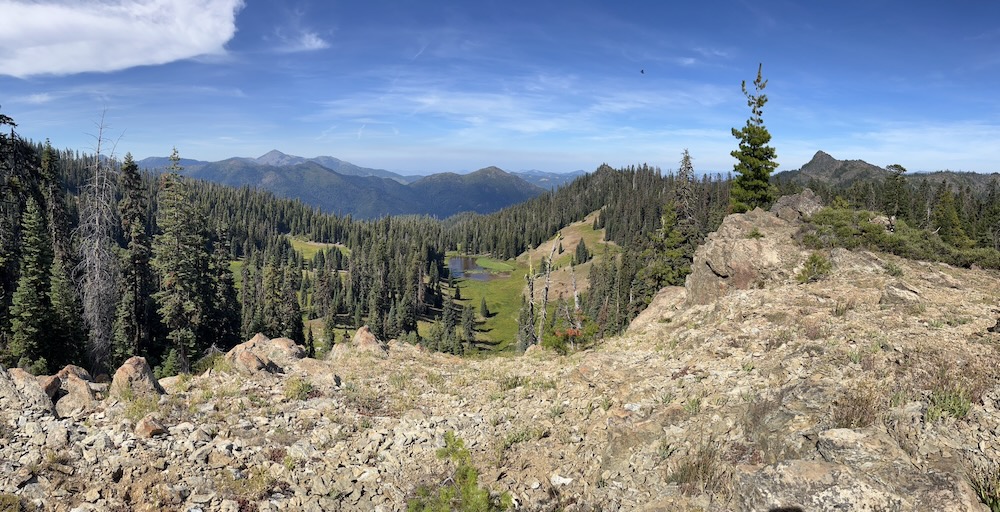
In 2025 Applegate Siskiyou Alliance has been busy across the Applegate Siskiyou region opposing damaging federal land management projects, discovering rare conifer populations, and supporting a vision for the future in what sometimes feels like bleak times. While our federal government focuses on viewing federal lands as a “balance sheet” and as “assets” to liquidate, we are focused on protecting, defending, appreciating, restoring, rewilding, and connecting with our public lands.

Although the Trump administration sees our backyard forests as resources to exploit, these public lands mean a lot more to the folks who live in this region. Public lands provide clean water, wildlife, native fisheries, healthy environments, outdoor recreation opportunities, scenic beauty, and significant economic benefits as intact habitats.
Protecting public lands in the Applegate supports local farms, vineyards and tasting rooms, strong real estate values, and businesses in the valley and beyond. This includes restaurants, vacation rentals, hotels, grocery stores, and other tourism, amenities or recreation related businesses.
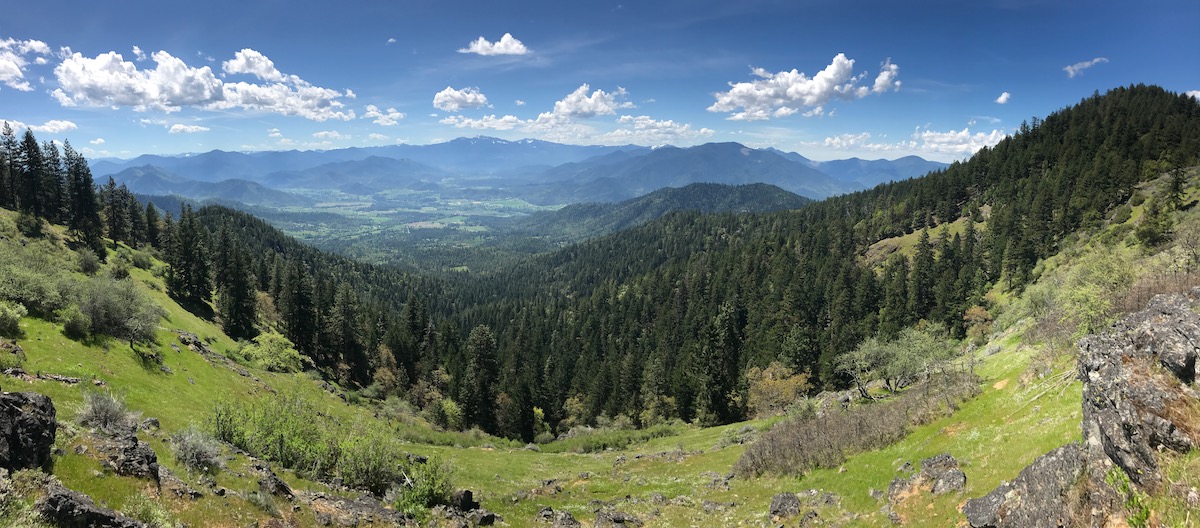
Together the attractions of southwest Oregon create a unique experience for visitors and residents alike, and outdoor recreation in the mountains of the Applegate is one of the region’s most cherished destinations. The Applegate has world-class paragliding, hiking, mountain biking, backpacking, bird watching, and sightseeing, which can be leveraged for economic benefit while simultaneously maintaining the intact wildlands on our public lands, and the quality of life for surrounding communities.
Public land logging is currently degrading the viewsheds, recreational trails, and water supplies of the Applegate region, impacting our quality of life, undermining our economy, increasing fire risks around our communities, and negatively impacting the lives of local residents, especially those with new clearcuts in their backyards or within view of their properties.
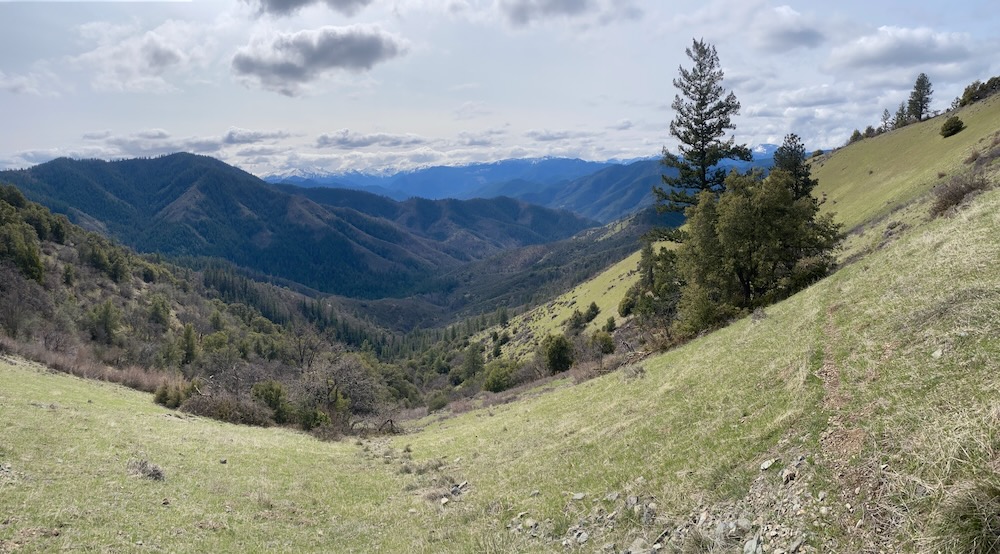
During these unprecedented and regressive times, a couple of things are becoming increasingly evident: 1) Currently we cannot depend on the federal government to sustainably or responsibly manage public lands. 2) The only way our local public lands will be protected and managed for public good and biological integrity, is if residents and visitors who love this region stand up to defend them.
YOU can help protect public lands by working with ASA in 2026 as we stand up as a voice for the Applegate Siskiyou!
Below are issues and projects we worked on in 2025, and some we expect to continue working on in 2026.
Addressing Threats
BLM Salvage Logging: SOS Project and other Timber Sales
The view of public lands coming out of Washington DC is one of “asset” management, which sees the publicly owned resources found on these lands as part of America’s “balance sheet.” Local land managers are being told to drastically increase timber production and to industrialize our public lands for short-term profits. This has led to a frenzy of logging proposals by the Medford District BLM in the Applegate Valley and recent timber sales implemented by the BLM have led to disastrous impacts in the Applegate River watershed.
Using blatant misinformation, BLM is selling a false narrative that nearly all Douglas fir forests below 3,500′ elevation will die within the next 3-5 years. This false logic is being used to justify the logging of nearly all living and dead standing trees, and the agency has been logging in mature, living stands with as little as 10% tree mortality.
The BLM’s narrative that all Douglas fir forests are going to die in 3-5 years actually started two years ago, so at this point, if their narrative is correct, all Douglas fir forests below 3,500′ in the Applegate will be dead within a couple years from now. This fear-based narrative is not only dishonest and hyperbolic, it requires us all to ignore the reality that the interior or many stands, north-facing slopes, east-facing slopes, and canyon bottom fir forests are surviving, and the recent flat headed fir borer outbreaks have largely subsided.
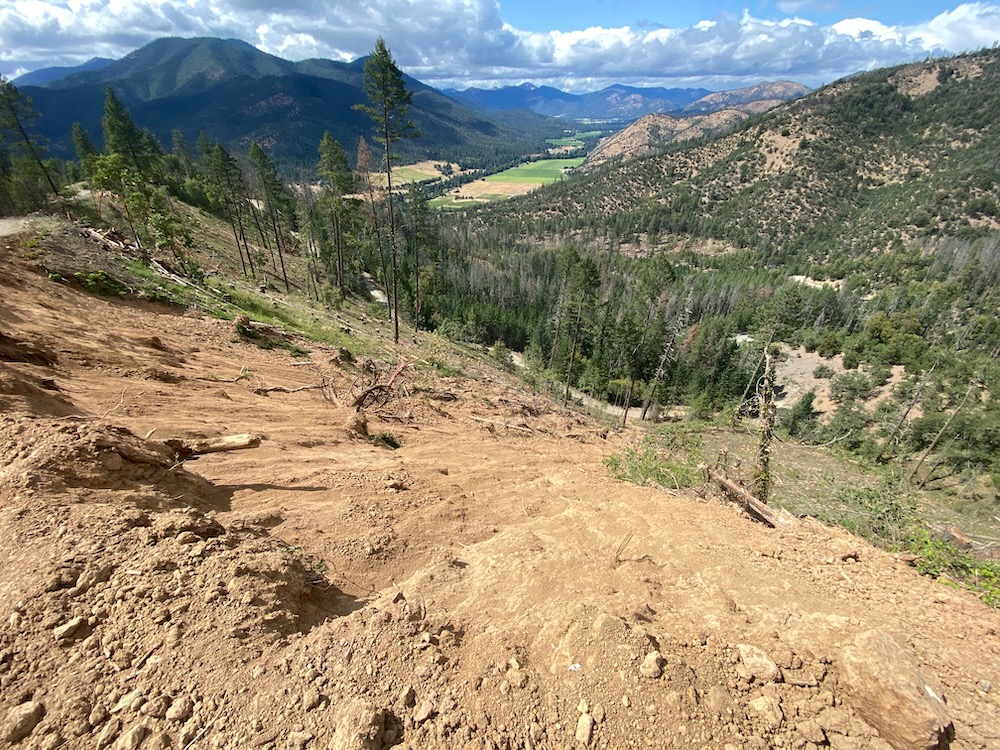
In the past two years, BLM has clearcut the slopes above Lick Gulch and the Little Applegate River in the viewshed of the Sterling Ditch Trail system in the Lickety Split Timber Sale. They have logged off the slopes of Forest Creek in the Forest Creek Salvage Timber Sale, and have devastated the face of Cinnabar Ridge on the lower end of both the Little Applegate and Upper Applegate Valleys, triggering landslides, debris flows, heavy stream sedimentation, and denuding previously green forests of nearly all commercially viable trees in the Boaz Salvage Timber Sale.
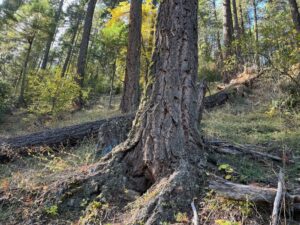
Recently, the scale of this logging has increased, with BLM approving additional timber sales under their massive SOS Project. These timber sales, which could log over 5,000 acres, are proposed across the Applegate Valley, from Thompson Creek to Sterling Creek and all in between. This includes the Thom Bone Timber Sale on Thompson Creek and Ferris Gulch, the Holcomb Hollow Timber Sale on Woodrat Mountain, above Sterling Creek and along the East Applegate Ridge Trail, and the Apple Saws Timber Sale on the eastern face of Ben Johnson Mountain above Cantrall Buckley County Park.
ASA is vigorously opposing these new projects and this new approach of logging off living, green, mature forests under the guise of “mortality salvage.” We will continue that work in 2026.
Douglas Fir Mortality Complex
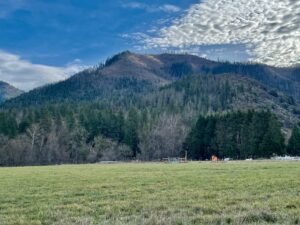
Yet another timber sale in the Applegate!
A brand new BLM logging project, apparently modeled off the SOS Project, but even larger, is targeting so-called “dead and dying” trees in the Applegate Valley. Yet, just like recent BLM timber sales, the project would also log trees that are both dead and alive across thousands of acres. This project is called the Douglas Fir Mortality Complex, and is currently subject to a BLM public comment period until January 14, 2026.
This additional timber sale area includes potential units all up and down the Little Applegate Valley, from the scenic river canyon near the Sterling Ditch Trail’s upper trailheads, to Sterling Creek, lower Yale Creek, Grouse Creek and down to the Upper Applegate Valley where units are proposed on lower Star Gulch, on the west face of Boaz Mountain, and on the slopes of Cinnabar Ridge in forests already streaked in clearcuts from the Boaz Salvage Timber Sale.
In total, approximately 8,000 acres of logging has been proposed in the eastern portions of the Applegate Valley, and as we have seen in previous “salvage” logging projects in the Applegate Valley, more tree mortality would be created in BLM timber sale units from logging than all other forms of natural mortality combined, including drought, and beetle infestations.
We will vigorously oppose this audacious BLM timber grab in 2026 and defend the forests of the Applegate from the BLM who “manages” them!
Cedar Flat Timber Sale
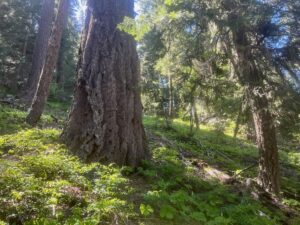
ASA has been working on BLM’s Cedar Flat Timber Sale since the summer of 2024, and we have successfully advocated for the cancellation of numerous old-growth units on the flanks of Grayback Mountain, on Holcomb Peak, and on Little Sugarloaf Peak. We are excited these units have been canceled and removed from the Cedar Flat Timber Sale, and that the BLM has responded positively to community feedback and concern.
The Cedar Flat Timber Sale is being proposed in Late Successional Reserve (LSR) forest, set aside to protect old forest habitat for the northern spotted owl. We intend to advocate for the protection of mature, late successional and old-growth characteristics throughout the Cedar Flat Timber Sale area and this large LSR forest at the headwaters of Williams Creek. An Environmental Assessment (EA) and public comment period could be initiated any day now, and we expect to be working on the Cedar Flat Timber Sale into 2026.
Join us on a field trip to the Cedar Flat Timber Sale with representatives of BLM on December 18, 2025 9:oo AM to 1:00 PM. Meet at the Williams Grange to carpool.
Documenting Diversity and Public Lands Stewardship
Subalpine Fir discovery

In the summer of 2024, ASA led the Siskiyou Crest Conifer Field Trip Series, which visited every conifer species found in the Siskiyou Crest region. This exploration of the region’s conifer diversity and backcountry included eight field trips visiting conifer forests and habitats of all sorts.
We visited lush forested canyons filled with old-growth Port Orford-cedar, dry mixed conifer forests to see a single gray pine tree near Little Grayback Mountain, and the high country of the Siskiyou Crest to see subalpine relicts like Alaska yellow-cedar at Whisky Peak, lodgepole pine at Tamarack Meadows, Engelmann spruce and subalpine fir at Mt. Ashland, and more.
In July, 2024 we visited a robust population of prostrate common juniper creeping over high elevation rock outcrops northeast of Dutchman Peak on the Siskiyou Crest. During this field trip, ASA executive director, Luke Ruediger saw a low krummholz mat (naturally shaped bonsai form) of blue-green conifer growth. It appeared to be subalpine fir and he took note of its location. This past summer, we brought a group of expert botanists to the site to verify this rare conifer population, and voucher specimens have now been submitted to the Oregon State University Herbarium and the Cal Poly Humboldt Herbarium.
The population is indeed rare, being one of only three populations of subalpine fir in the Siskiyou Crest region and the only population in the Applegate River watershed. This newly documented population of subalpine fir would most likely not have been discovered without the conifer field trip explorations sponsored by ASA in 2024, and our further work to document the population with expert botanists and herbarium submissions in 2025.
A Siskiyou Crest White Paper will be published in 2026 about subalpine fir in the Siskiyou Crest region.
Nick Wright Flat Pollinator and Native Plant Restoration
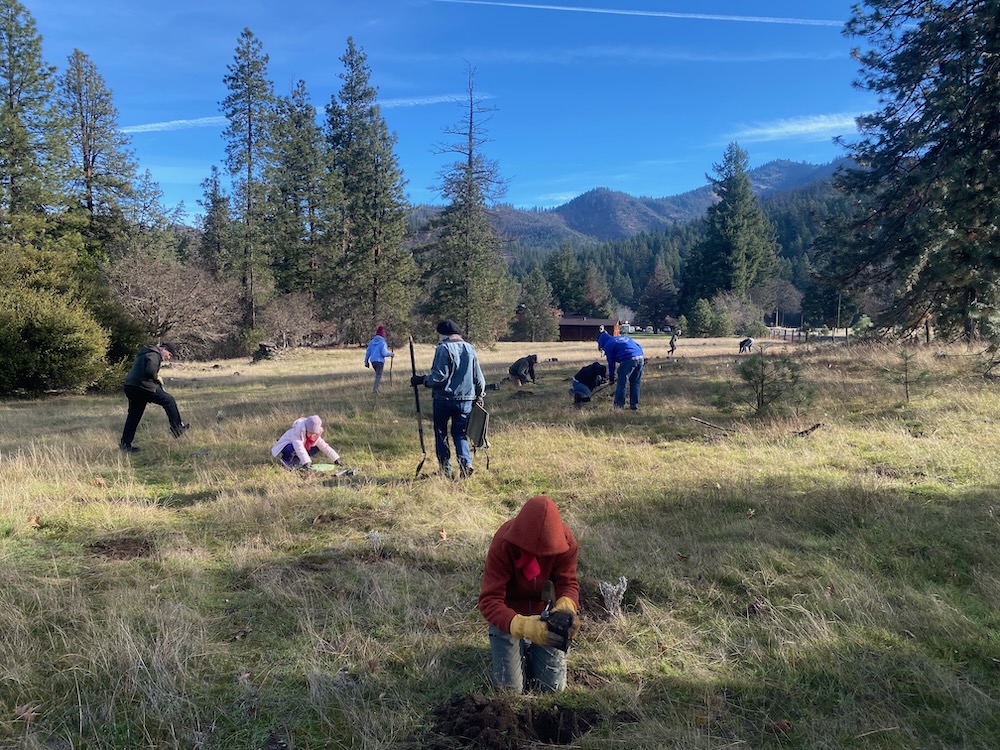
In 2025 ASA continued our long-standing efforts to restore native pollinator habitat with native plants at Nick Wright Flat, a rare valley bottom Forest Service parcel along the Applegate River. For eight years ASA has worked with the Forest Service planting and seeding native herbaceous plants in a large weedy river terrace adjacent to homes and ranches in the Upper Applegate Valley. The site contains existing native plant habitat with some important and robust native plant populations. ASA has also pulled noxious weeds, like yellow star thistle, to help control invasive plants, and we have been planting containerized native nursery stock and sowing native seeds collected in nearby habitats.
Over time native plant populations have begun taking hold in small self-sustaining populations throughout the large riverside terrace. We hope to continue planting nursery grown native plants, sowing native seeds, and restoring native plants at Nick Wright Flat in 2026.
THANK YOU to all the volunteers that have contributed to this native planting and seeding effort! We can’t do it without you!
Turtle Tales: Pond Turtle Field Trip & Online Webinar
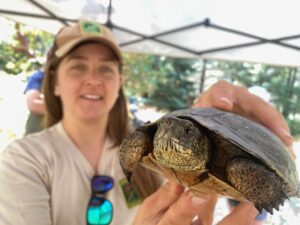
ASA held an online webinar and field trip to Acorn Women Lake about Western pond turtles—a declining species and candidate for listing as a threatened species under the Endangered Species Act—with Jade Keehn, wildlife biologist for the Oregon Department of Fish and Wildlife, and Erin Considine, wildlife biologist for the US Forest Service. We walked around Acorn Women Lake, viewed pond turtles, learned about their ecology, and also participated in a long-term monitoring project at the lake, where an estimated 200+ turtles live and are monitored yearly.
Game Camera Wildlife Monitoring
ASA monitors wildlife in the Applegate Siskiyou region using game cameras to document wildlife populations, wildlife movement and wildlife behavior. Below is a series of awesome video clips of a black bear mama and cubs at a local spring and bear wallow. This video has had over 10,000 views on ASA’s facebook page and has been shared widely because it’s pretty amazing footage. Check it out, it might just make your day! We could watch it over and over again.
Building a foundation for future protections
Siskiyou Crest Coalition
ASA is proud to be an active member and fiscal sponsor for the Siskiyou Crest Coalition (SCC), a collaboration of non-profit organizations, businesses, and individuals promoting permanent habitat protections for the Siskiyou Crest region.
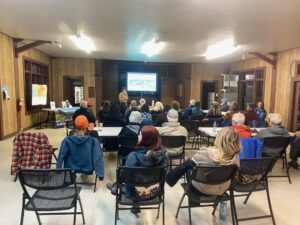
SCC has been working on many foundational projects in 2025, increasing our outreach capacity both in southern Oregon and northern California. We have been making presentations around the region about the wonders of the Siskiyou Crest and have been organizing some exciting projects to explore the science and the biodiversity of the Siskiyou Crest region.
In 2026 SCC will host another Siskiyou Crest Artist in Residence at Acorn Woman Lookout and will sponsor the Siskiyou Crest Moth Project.
For more information visit the Siskiyou Crest Coalition website and sign up for email updates and sign our petition for the Siskiyou Crest.
Other Notable Events
ASA led a public wildflower hike to see the fire induced super bloom in the 2024 Upper Applegate Fire footprint. Leading the hike a year later in the spring of 2025 flowers and grasses had colonized the burned soils and stump sprouting shrubs and hardwood trees had already begun their recovery.
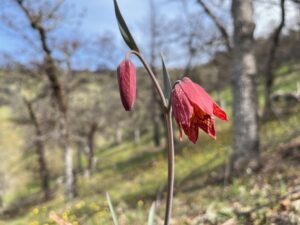
Although we visited the area slightly early for the super bloom, the flowers were still great and we did have the pleasure of viewing the rare Gentner’s fritillary in full bloom!
In spring 2025 the Ruch Library hosted a public panel presentation about conservation in the region. Luke Ruediger from ASA was a featured panelist at the presentation.
ASA and the Siskiyou Crest Coalition also made presentations in Mt. Shasta and for the Friends of Ahart Herbarium in Chico, California. We also participated in an EcoNews Report radio interview with Tom Wheeler, Executive Director for northern California’s Environmental Protection & Information Center (EPIC).
ASA pushed back in coalition with conservation groups across the country to oppose the Trump Administration proposals to eliminate the Roadless Rule. The Roadless Rule protects millions of acres nationwide, including large unroaded swaths of intact forest and woodland across the Applegate River drainage and across the Siskiyou Crest.
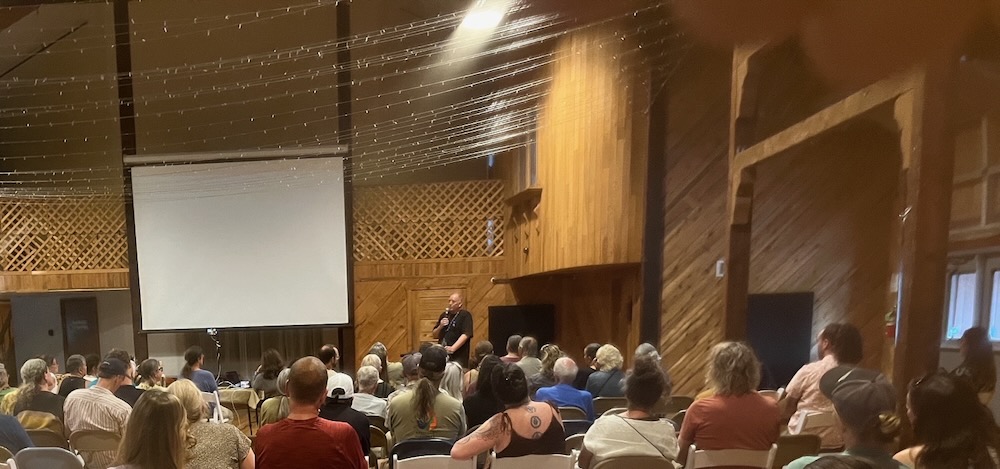
We also hosted a wonderful presentation with Robert Kentta from the Confederated Tribes of Siletz Indians. Robert’s great-grandfather was born in the Applegate and was orphaned during the Rogue Indian Wars before being forcefully removed on the Oregon “Trail of Tears.” His presentation covered tribal history of the Applegate area. We learned a lot and were both honored and grateful to host Robert and so many of his relatives at this large public presentation at Pacifica Gardens in Williams.
2026: Storms brewing on the horizon
The Applegate Siskiyou is threatened like never before, and more than ever before we need a strong grassroots response. ASA is committed to providing a strong response on behalf of the wildlands in this spectacular, diverse, and regionally important landscape. We know the beauty and the biological value of this incredible region, and we see the storms brewing on the horizon.
Our goal is to weather the coming storm, while maintaining the biodiversity and beauty of the wildlands in the Applegate Siskiyou. We will fight for this region in 2026, defending old forests, intact habitats, wildlife, watersheds, and wildlands, while working to support a vision for the future that protects, respects, restores and rewilds the spectacular Applegate Siskiyou region.
Join us in 2026 and consider a generous year end donation!